Kyo Ware Mugs: Four Kyoto Artisans Compared by Glaze and Shape

Look for Kyo ware or Kiyomizu ware mugs and you will find mugs with a pattern like cracked ice, cups that look like old iron, white porcelain mugs with raised flowers, and round mugs painted with a dog. They are all "Kyoto mugs," yet they look nothing alike.
Kyo ware and Kiyomizu ware are not tied to a particular clay or style. The names cover pottery fired in Kyoto in general, and the techniques and colors differ from one artisan to the next. So the quickest way to choose a mug is by the artisan's glaze and shape, not by the name of the region.
This guide uses mugs and coffee cups by four Kyoto artisans that nokaze carries now to cover the differences in glaze and body, how to pair them with drinks, how to choose a shape and size, and how to care for them.
If you would rather see the pieces first, the Kyoto collection brings together work by Kyoto artisans.
Kyoto Mugs Have No Fixed Style
Kyo ware (kyo-yaki) is the general name for pottery fired in Kyoto, and pieces fired around Gojozaka, the slope leading up to Kiyomizu-dera temple, have been called Kiyomizu ware (kiyomizu-yaki). As the capital, Kyoto drew artisans and commissions from all over Japan, and its potters brought in clays and kilns from elsewhere while changing shapes and painting to suit each order. That is why there is no single look that says "this is Kyo ware."
A mug is something you pick up every day, so beyond its looks, the weight in your hand, how the rim feels on your lips and how easy it is to wash also matter. The history and character of the ware are covered in Kyo ware, and plates by the same artisans in Kyo ware plates.
Mugs by Four Kyoto Artisans: Telling Them Apart by Glaze and Shape
First, here are the four artisans' mugs side by side. Looking at the character of the glaze and the body (stoneware or porcelain) makes choosing easier.
| Artisan | What sets the mugs apart | How they look | Drinks and moments |
|---|---|---|---|
| Kawai Taichi | Stoneware in "ice-crackle glaze," with a pattern like cracked ice | Deep blue, or a grayish lavender. The pattern differs on every piece | Coffee, tea, slow moments |
| Maeda Asami | Porcelain with flower patterns raised in slip trailing and relief | Bronze and pale blue-green. Glaze pools in the relief | Morning coffee, hojicha |
| Hirai Shu | "Black gold" glaze with the texture of aged iron | Silver and rust tones on black outside, green glaze inside | Coffee, drinks you want to show off in color |
| Tanaka Daiki | A two-person studio: Tanaka Daiki shapes, Tanabe Kei paints | Dogs and flowers painted under the glaze on white | Breakfast, milk or soup, gifts |
Kawai Taichi: An "Ice-Crackle Glaze" Like Cracked Ice
Kawai Taichi works at Tobo Usurai in Kameoka, Kyoto Prefecture, and finishes the pieces in a glaze called ice-crackle glaze. Fine crazing (a network of cracks in the glaze) runs across the surface, so a pattern like cracked ice spreads differently on every piece. The photo below shows "Suiho," inspired by bubbles under water, in deep blue. "Kurage," inspired by jellyfish drifting among flowers and in the sea, is a gradation of grayish lavender.
The shapes are simple and the texture of the glaze takes center stage. A look that holds both coolness and warmth is what defines Kawai's work. In the same glazes there are also low coffee cups (large and medium) as well as mugs. Pieces with crazing are also gathered in the crazing collection.

Maeda Asami: Flowers Raised on Porcelain
Maeda Asami raises patterns on a porcelain body with icchin (drawing lines by squeezing slip from a dropper) and relief. On the bronze-glazed mug in the photo, flowers stand out inside diamond panels, and glaze pooled in the relief creates light and dark. It has the shine of metallic crystals and the presence of metalwork that has been used for years.
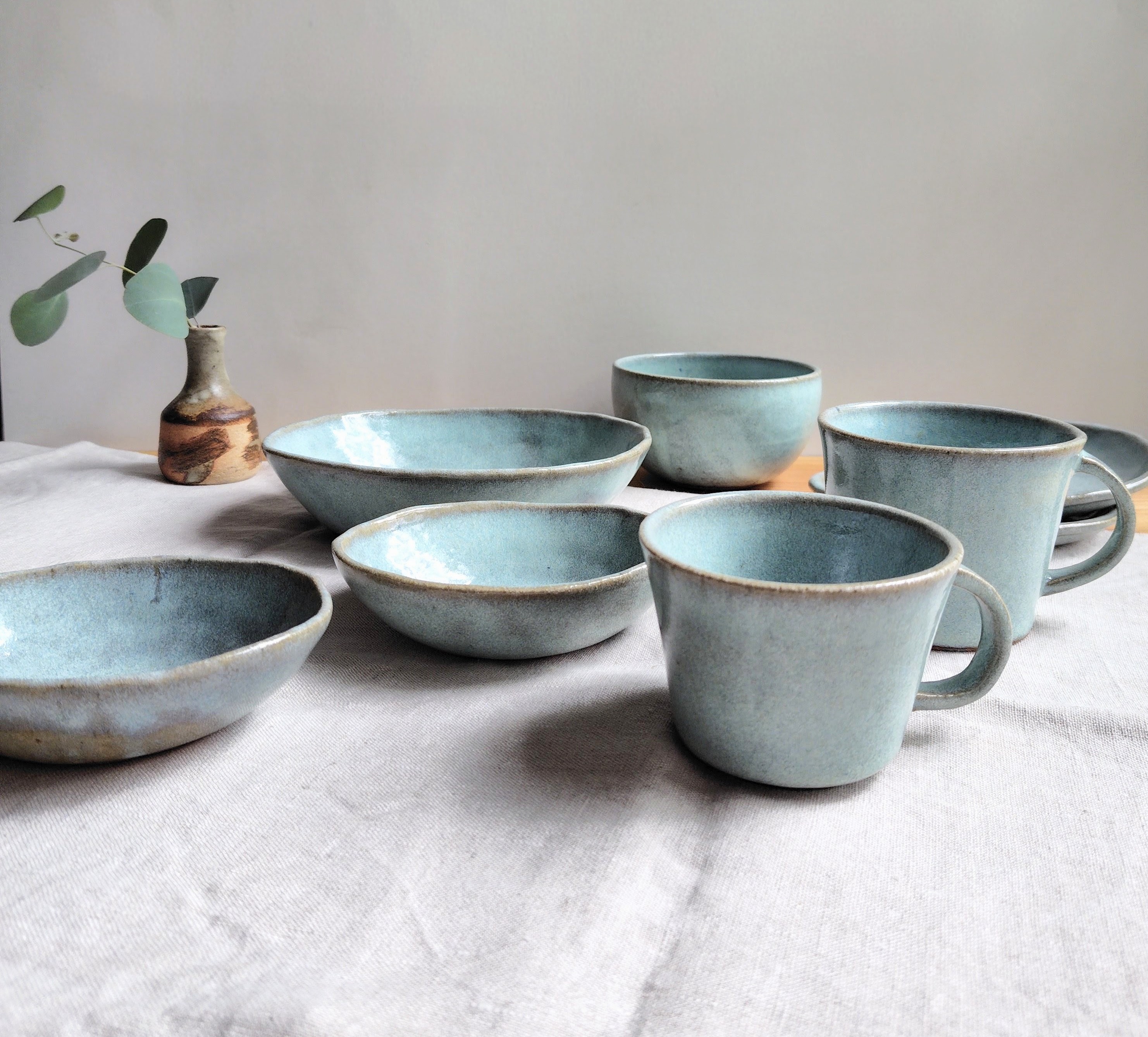
As the photo at the top of this article shows, there is also a mug with the same pattern finished in a pale blue-green glaze. This color sits easily on a white table. Both are straight cylinders about 9 to 10 cm tall, and the pale blue-green glaze also comes as a wide-mouthed coffee cup. With this artisan, choosing by color makes it easy: metallic glaze bronze, or a soft pale blue-green. The technique and the artisan's story are covered in our artisan profile of Maeda Asami.

Hirai Shu: Iron-Like Black Gold Outside, Green Inside
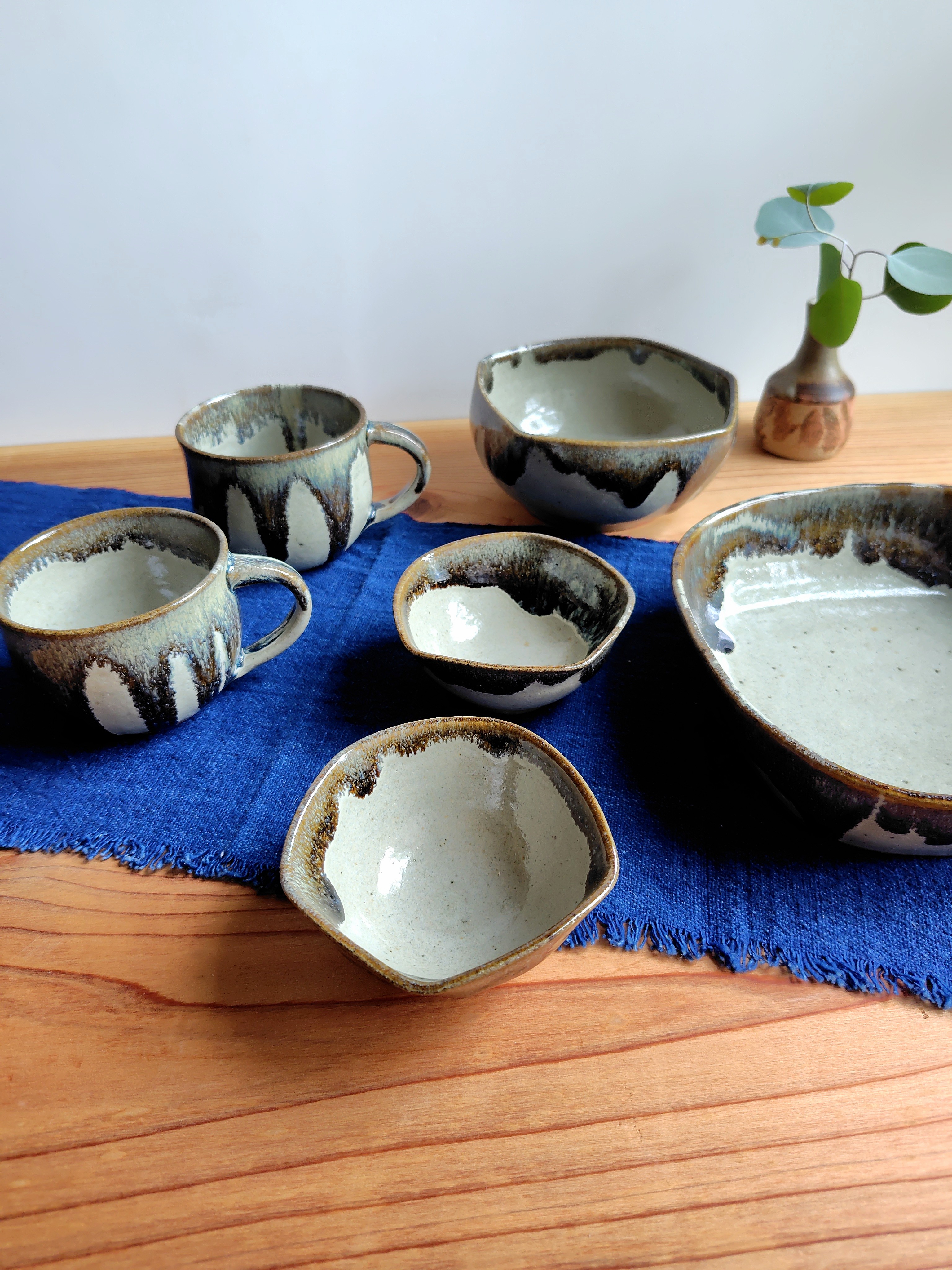
Hirai Shu's "black gold" series captures the texture of aged iron in an original glaze. On the black gold and green glaze coffee cup in the photo, silver and rust tones are mottled across a black ground outside, and a deep green glaze lines the inside. It looks substantial, but it is light in the hand and smooth to the touch, so it works for every day.
When you pour coffee, the green inside shows only as a thin line at the rim, then appears little by little as you drink. It is a cup that changes until the last sip.

TATA pottery studio: A Round Mug With a Dog
TATA pottery studio is a two-person studio: Tanaka Daiki shapes the pieces and Tanabe Kei paints them. Their easy-to-use shapes follow the idea of "beauty in use," painted with somewhat retro pictures using underglaze painting. Mug B in the photo is a round shape with a lying dog, and a blue checkered band runs around its base. At about 7 cm tall it sits low, a mug you can cup in both hands that brightens the breakfast table. The studio's story is in our profile of TATA pottery studio.

Choosing by Shape and Size
Once you have chosen an artisan, look at the shape. Even among Kyoto artisans' pieces, a tall mug and a low coffee cup feel different to use.
| Shape | How to use it | Examples in this guide |
|---|---|---|
| Straight mug (about 9 to 10 cm tall) | Holds plenty and stays warm. For a break between work | Maeda Asami's bronze and pale blue-green mugs |
| Mug with a slightly wider mouth (about 8 to 8.5 cm tall) | Lets the aroma rise and fits the hand. For everyday coffee or tea | Kawai Taichi's mugs, Hirai Shu's black gold and green glaze coffee cup |
| Round mug (about 7 cm tall) | Fits in both hands. For milk or soup, or breakfast with children | TATA pottery studio's Mug B |
| Low coffee cup | For a shallow pour drunk before it cools. Pairs well with a small plate | Kawai Taichi's coffee cups, Maeda Asami's pale blue-green coffee cup |
Handmade pieces vary a little in size, so check the exact dimensions on each product page. How a handmade mug changes your drink is covered in Japanese pottery mugs. To choose from artisans beyond Kyoto too, browse our handmade Japanese mugs.
Caring for Kyoto Artisans' Mugs
Care depends not on whether a piece is from Kyoto, but on the body and the glaze.
- Porcelain (such as Maeda Asami's mugs) It absorbs almost no water, so simply wash and dry it. Wash raised patterns with a soft sponge
- Crazed glazes (such as Kawai Taichi's mugs) With use, coffee or tea can seep into the crazing and the pattern gradually darkens. If you would rather avoid this, wash the mug right after use and dry it well
- Metallic-looking glazes (bronze, black gold and so on) Avoid abrasive sponges
Whether a piece can go in the microwave or dishwasher depends on the artisan and the piece, so check the description on each product page. How to tell is covered in microwave and dishwasher, and everyday care in stoneware care.
Related Articles and Terms
Getting to Know Kyoto Pottery
- Kyo Ware and Kiyomizu Ware: Kyoto's Refined Ceramics
- How to Choose Kyo Ware and Kiyomizu Ware Plates: Five Kyoto Artisans Compared by Body and Glaze
- Artisan Maeda Asami | Japanese Porcelain Patterned in Relief, Not Paint
- TATA pottery studio | The Charming Kyoto Porcelain Two People Make Together
Techniques and Choosing a Mug
- Crazing (Kannyu): Cracks in Glaze That Aren't Damage
- Icchin: Slip Trailing, the Raised Dot Technique
- Shita-etsuke: Underglaze Painting and Why It Never Fades
- Japanese Ceramic Mugs: Why Handmade Changes Your Coffee
Browse
- Kyoto Pottery | Kyo-yaki & Kiyomizu-yaki Ceramics
- Kawai Taichi | Ice-Crackle Glazed Bowls & Coffee Cups
- Maeda Asami | Bronze & Ash-Blue Glazed Porcelain, Kyoto
- Hirai Shu | Metallic Glaze Sake Ware, Cups & Plates, Kyoto
- TATA pottery studio | Bears & Girls, Hand-Painted Ware
- Japanese Mugs | Handmade Ceramic Mugs from Japanese Potters
Mugs by Kyoto Artisans, for Your Everyday Cup
Blue and lavender like cracked ice, flowers raised on porcelain, iron-like black gold with green inside, a dog painted on a round mug. Because Kyo ware has no fixed style, there are as many faces of the mug as there are artisans. At nokaze, you can browse Kyoto artisans' mugs one piece at a time.
See Kyoto potteryFAQ
Is there anything Kyo ware and Kiyomizu ware mugs have in common?
How should I choose between a mug and a coffee cup?
Is it all right if color gets into a crazed mug?
Shop the related pieces
Kyoto
37 pieces See all
Ryosuke Matsuo
Foliate Oval Plate, Brown No.1
$302.00
Plates

jiucasca
Ash-Blue Glaze Coffee Cup — Kyoto
$364.00
Japanese Coffee Cups

jiucasca
Blue-White Porcelain Foliate Arabesque Plate, Small
$238.00
Plates

Tobo Usurai
Ice-Crackle Rice Bowl, Large — Bubble Blue
$316.00
Japanese Rice Bowls
Japanese Mugs
73 pieces See all
Utsuwa no Yukue
Pine Ash Glaze Compact Mug
$252.00
Japanese Coffee Cups
jiucasca
Ash-Blue Glaze Coffee Cup — Kyoto
$364.00
Japanese Coffee Cups

yoshida pottery
Ball-Footed Coffee Cup, Brown
$435.00
Japanese Coffee Cups

Kawasumi Tomokazu
Woodgrain Yunomi Teacup — Kasama
$182.00
Mugs
New to Japanese pottery? Start here — its history, how pottery differs from porcelain, the clays and glazes behind each style, and how to care for a piece. → Japanese Pottery: The Complete Guide