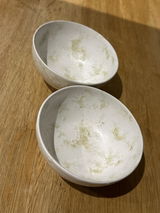

Anagama: Inside Japan's Oldest Wood-Fired Kiln

An anagama is a single-chamber kiln built by digging into a hillside. Fuelled by wood, it lets flame and ash act directly on the pieces, producing one-of-a-kind scenery such as yohen and natural ash glaze.
It arrived from the Korean peninsula around the 5th century and lifted Japanese ceramics from earthenware to stoneware. Every one of Six Ancient Kilns began with this kiln.
There are no partitions inside; the flame passes straight from the firemouth to the chimney at the far end. That simple structure changes a piece's expression dramatically according to where it stands.
Anagama against noborigama
| Aspect | Anagama | Noborigama |
|---|---|---|
| Structure | One undivided chamber | Chambers linked in steps up a slope |
| Flame path | Straight from firemouth to chimney | Waste heat from one chamber feeds the next |
| What it suits | Bringing out strong ash and flame effects | Firing quantity evenly and efficiently |
| An analogy | A single room | A block of connected rooms |
The evolution of the anagama is the noborigama. For a fuller comparison see our guide to Japanese wood kilns.
Going into the kiln with no glaze
Much of the Bizen and Shigaraki fired in an anagama goes in as raw clay, with no manufactured glaze applied beforehand.
That it still comes out with distinctive color and sheen is thanks to natural ash glaze. Over days of burning wood, a great quantity of ash rises inside the kiln. It settles on the work, and above 1,200°C it reacts with the feldspar and silica in the clay, melts, and turns into a natural glassy layer.
Position decides everything. Near the firemouth a piece takes a thick coat of ash; deep in the kiln, only a little. Upward faces gather ash, downward faces do not. Makers spend days packing a kiln for exactly this reason.
Why the risk of failure is high
- The flame is extremely hard to control Wind direction, humidity and the state of the wood change the temperature and the flame path inside the kiln second by second.
- The risk of being buried in ash Wood is thrown in continuously, so pieces near the firemouth end up completely buried in embers and ash. Sometimes that becomes exquisite scorching; sometimes it warps or cracks the work.
- Long physical labour A single firing means stoking around the clock for several days, sometimes more than a week.
After a battle fought in heat and sleeplessness, it is not unusual to open the kiln and find more than half unsaleable. It is precisely because it is a serious contest with fire that this particular beauty appears.
Related terms and guides
Related terms
- Noborigama: The Climbing Kiln, Chamber by Chamber
- Shizen-yu: Natural Ash Glaze Explained
- Bidoro: The Glass-Green Drips on Bizen Pottery
- Yakishime: Unglazed Pottery Fired to Its Limit
- Hidasuki: The Red Straw Marks on Bizen Pottery
- Japanese Pottery Glossary | Terms, Techniques & Kilns
Read further
- Anagama vs Noborigama: Japanese Wood Kilns Compared
- Japan's Six Ancient Kilns: All 6 Regions Compared
- Yohen: When the Kiln Decides the Colour
- Bizen Ware: Pottery With No Glaze at All
Pieces available at Nokaze
Look at an expression the flame decided
Where a piece stood in the kiln becomes, directly, its face. Nokaze introduces wood-fired pottery together with the background of its makers.
Browse unglazed stonewareFAQ
What is the difference between an anagama and a noborigama?
Is it true that no glaze is applied to the work?
Why is the risk of failure said to be high with an anagama?
Shop the related pieces
Unglazed Stoneware
99 pieces See all
Shimizu Yayoi
Yakishime Coffee Dripper, Small — Bizen Ware
$399.00
Japanese Coffee Cups

Bizen Ware Artist Fujiwara Akira
Hikidashi-guro Skull Sake Cup — Bizen Ware
$1,448.00
Japanese Sake Ware

Bizen Ware Artist Fujiwara Akira
Hikidashi-guro Guinomi Sake Cup No.2 — Bizen
$941.00
Japanese Sake Ware

Bizen Ware Artist Fujiwara Akira
Hikidashi-guro Bamboo Plate — Bizen Ware
$1,448.00
Plates
Bizen
82 pieces See all
Shimizu Yayoi
Yakishime Coffee Dripper, Small — Bizen Ware
$399.00
Japanese Coffee Cups
Bizen Ware Artist Fujiwara Akira
Hikidashi-guro Guinomi Sake Cup No.2 — Bizen
$941.00
Japanese Sake Ware
Bizen Ware Artist Fujiwara Akira
Hikidashi-guro Skull Sake Cup — Bizen Ware
$1,448.00
Japanese Sake Ware
Bizen Ware Artist Fujiwara Akira
Hikidashi-guro Bamboo Plate — Bizen Ware
$1,448.00
Plates
New to Japanese pottery? Start here — its history, how pottery differs from porcelain, the clays and glazes behind each style, and how to care for a piece. → Japanese Pottery: The Complete Guide