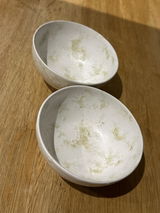

Satsuma Ware: The Gold-Painted Porcelain That Wowed Paris

At the Paris Exposition of 1867, Satsuma ware reached the world and captivated it. An ivory body. Painting so fine that you cannot take it all in without a magnifier. A world of courtiers, warriors and dragons outlined in gold. Could pottery like this really have been made on an island on the other side of the earth? More than 150 years after that shock, the name "Satsuma ware" still carries a particular resonance in the global antiques market.
What Satsuma Ware Is
Satsuma ware is the collective name for ceramics produced across what is now Kagoshima Prefecture. Say "Satsuma ware" and you are actually referring to two lines with very different characters. Understanding those two lines is the first step into the subject. Satsuma also has a deep samurai history, and part of the tradition grew out of pottery made for the upper ranks of the warrior class.
The Origins of Satsuma Ware
The story of Satsuma ware begins on the Korean Peninsula, as it does for Arita ware, Hasami ware and Hagi ware.
During the invasions of Korea launched by Toyotomi Hideyoshi, who had unified Japan, the lord of Satsuma at the time, Shimazu Yoshihiro, brought Korean potters back to Japan. Forced to leave their homeland, they settled at Naeshirogawa in what is now Hioki City and laid the foundation of Satsuma ware.
Korean technique was transplanted into the soil of Kyushu and, generation by generation, fused with a Japanese sense of beauty. But those Korean roots are still carved deeply into the DNA of this pottery.
The potters' community at Naeshirogawa maintained its own society and cultural identity for centuries. Their descendants still make pottery there today, known as Naeshirogawa ware.

The Two Types of Satsuma Ware
Satsuma ware falls into two broad types, described in detail below.
Shiro-Satsuma (white Satsuma)
Fine work in which a milky-white to ivory body carries precise enamel painting and gilding. These were formal, made-to-order pieces produced for the upper warrior class, with delicate painting throughout. What is known as "Satsuma ware" in the Western antiques market is mostly this.
Kuro-Satsuma (black Satsuma)
Everyday pieces for farmers and ordinary people, covered in a glossy black glaze. Substantial and practical, with no ornament at all, they are work born of beauty through use. Fittingly for Kagoshima, a shochu-producing region, they have long been loved as drinking ware.

The White Satsuma That Captivated the West
Shiro-Satsuma was never intended for ordinary people. It was a prestige good demonstrating the wealth and standing of the Satsuma domain, made for the lord and the upper warrior class alone — work meant to bring splendour into daily life.
Its characteristics: the body is a warm milky-white to ivory produced by firing local clay, and the surface deliberately carries the fine crazing that runs across the glaze.
Over that, red, blue, green, yellow and black enamel pigments are painted with an extremely fine brush and outlined in gold — work made, quite literally, for the upper warrior class.
The motifs are auspicious ones rendered down to the smallest detail: court scenes, Buddhist saints, landscapes, mythical creatures.
In the Edo period Shiro-Satsuma was not for sale. It was either a diplomatic gift demonstrating the authority of the domain, or a treasure kept in the storehouse of the lord and his senior retainers. It almost never reached the open market.
The Paris Exposition of 1867 changed that completely. The precision of the Satsuma ware that Westerners saw for the first time caused a sensation. The response was immediate and commercial. Exporters began building production for Western markets under the name "Satsuma ware."

The Other Satsuma: Kuro-Satsuma
While Shiro-Satsuma monopolised the Western imagination, Kuro-Satsuma remained almost unknown outside Japan for many years. That assessment is now changing.
Kuro-Satsuma is the opposite of Shiro-Satsuma in every respect. Thick walls, an unadorned form, thorough practicality. The deep, glossy black produced by wood ash and iron is powerful, and it settles into a modern minimal interior or table with surprising ease.
Its most representative form is the joka, a wide-mouthed drinking piece for pouring shochu and drinking directly. Heavy and warm in the hand, it has a rough presence that could be called sculptural.
For today's tableware collectors, Kuro-Satsuma offers a rare option: pottery with centuries of practical tradition behind it that also sits perfectly on a modern table. It is another face of Satsuma ware, entirely unlike the white.

Satsuma's Kiln Regions Today
Satsuma ware today is made mainly in two regions within Kagoshima Prefecture.
Naeshirogawa ware
Kilns whose origin lies directly in the settlement of Korean potters four hundred years ago. They make both Shiro-Satsuma and Kuro-Satsuma in traditional forms. Korean cultural roots still shape the identity of the community.
Ryumonji ware
Kilns based in Aira City, Kagoshima Prefecture. Centred on Kuro-Satsuma, they carry the tradition forward in forms that work in modern life. Both can be bought directly at the kilns or through specialist galleries in Japan.
What Satsuma Ware Still Says
Satsuma ware is not simply a collector's item. Its history holds a tangle of human stories: Korean potters taken from their homeland by war, a lord of Satsuma who used ceramics as a symbol of authority, and a global export industry born from Western enthusiasm.
A Shiro-Satsuma bowl fired for a domain lord in the Edo period. An export vase that crossed the Pacific in the Meiji era. Kuro-Satsuma shochu ware still made by the descendants of Korean potters. The weight of that history lives in each piece. That is what Satsuma ware brings.
Related Guides
More on the culture and history of Japanese ceramics
More on Japan's pottery regions
- Japanese Pottery by Region: A Buyer's Map
- Arita Ware: Japan's First Porcelain, 400 Years On
- Hagi Ware: The Tea Bowl That Changes Colour as You Use It
- Kutani Ware: Japan's Boldest Ceramic Painting
- Satsuma
How to choose Japanese ceramics
How to buy Japanese ceramics
- About Us|Japanese pottery & culture
- Buying Japanese Pottery Online: What to Check First
- New Arrivals
Pieces available at Nokaze
From the Clay and Fire of Kagoshima
Nokaze introduces pottery from Satsuma and regions across Japan, together with the background of the people who made it. Look for a piece standing in the lineage of Satsuma ware and its two traditions, white and black.
Browse SatsumaFAQ
What is Satsuma ware?
What's the difference between Shirosatsuma and Kuro satsuma?
Are antique "Satsuma" and modern Satsuma ware the same thing?
For the first move, should I choose white or black?
Shop the related pieces
Japanese Painted Ceramics
42 pieces See all
Higuchi Maki
Squid Plate, 15cm
$1,493.00
Plates

Komuro Shizuka
Hokkaido Flower Field Large Plate
$3,110.00
Plates

Higuchi Maki
Grape Free Cup, Blue and Red
$1,244.00
Japanese Tea Cups (Yunomi)

jiucasca
Sometsuke Floral Vase — Kyoto
$933.00
Japanese Vases
New to Japanese pottery? Start here — its history, how pottery differs from porcelain, the clays and glazes behind each style, and how to care for a piece. → Japanese Pottery: The Complete Guide