
Artisan Shibaoka Chikara | Raised in Imbe, Carrying Bizen Saikumono Forward

A robot built from Bizen ware parts held together with bolts and nuts. It was made by Shibaoka Chikara, who was born into Shibaoka Tosendo, a kiln in Imbe, Bizen City, Okayama Prefecture.
Where Shibaoka Chikara puts the most energy is Bizen saikumono, sculptural work that takes the form of animals, plants and still life. It is a Bizen ware technique that goes back to the early Edo period, but because it takes so much time and care, fewer and fewer artisans work in it today. Together with fellow artisans, Shibaoka Chikara has formed a group to pass this craft on to the next generation.
Shibaoka Tosendo is a Bizen ware kiln founded in 1912. Shibaoka Chikara began making pottery in 1995, mainly flower vases, sake ware and tableware, and has worked on Bizen saikumono since around 2005. Today Shibaoka Chikara keeps the kiln's fire going together with Shibaoka Kozan III, the third-generation head and Shibaoka Chikara's father, and Shibaoka Hisashi, a younger brother.
nokaze carries Shibaoka Chikara's pottery.
Growing Up in Imbe, a Town of Pottery
Imbe is a town where Bizen ware kilns gather. Shibaoka Chikara was born into one of its kiln families.
The family business is a Bizen ware kiln that has been running since 1912, and for as long as I can remember, I was surrounded by Bizen ware. Imbe being what it is, the houses across the street and next door, the older kids in the neighborhood, almost everyone was connected to Bizen ware. Imbe Elementary School had a climbing kiln, and the teachers would fire the things we students made in art class. The Imbe Shrine on the hill behind us, which enshrines the god of Bizen ware, was where we children played. I truly grew up in a town of pottery.
Honestly, I don't know what led to the style I have now, or whether there was a turning point. But I think growing up seeing Bizen ware wherever I went as a child has influenced me a great deal.
— Shibaoka Chikara
An elementary school with a climbing kiln, where even children's work is fired in a wood kiln. For Shibaoka Chikara, Bizen ware being part of daily life was not a special experience but simply ordinary everyday life. The history of Bizen ware is covered in Bizen Pottery History.

A Craft Not to Be Lost: Bizen Saikumono
Bizen saikumono is a genre of Bizen ware that brings the forms of animals, plants and still life into ornaments, incense burners, tea ware and sake ware. The robot at the top of this article also belongs to this tradition.
Bizen saikumono is a technique that runs unbroken through the history of Bizen ware. It has been made since the early Edo period, through ups and downs, but because saikumono takes so much time and effort, the number of artisans working in it has kept falling over the past few decades. It is far too precious a craft to simply fade from history.
There are not many of us, but the artisans who make saikumono have formed a group, and we hold exhibitions of saikumono alone, refine our skills together and work to reach the next generation. Bizen clay is very plastic, so it allows delicate detail. Nothing would make me happier than if future potters saw our work and decided to become saikumono artisans.
— Shibaoka Chikara
Plasticity is the quality of holding whatever shape force gives it. Bizen clay is high in plasticity, so even thin limbs and small parts can be shaped in detail. Because it is fired without glaze, the colors of the kiln's flame show directly on saikumono too. What makes Bizen ware itself distinctive is covered in Bizen Ware.

Firing Sangiri: The Difficulty of the Kiln
At Shibaoka Chikara's kiln, the focus is on sangiri, one of the fired colors of Bizen ware.
The hardest part is the firing. We fire in a wood kiln, so it can never be fully controlled. Sangiri is a way of firing where a large amount of charcoal is put on top of the pieces in a kiln of over 1200°C, and the gas from the burning charcoal reacts with the iron in the clay to bring out complex patterns. Too much or too little charcoal, adding it at the wrong moment, a kiln that is slightly too cool. If any one thing goes wrong, the color changes, and sometimes it does not turn out the way I pictured it.
— Shibaoka Chikara
The amount of charcoal, when it goes in, the temperature of the kiln. If just one of them is off, the color changes, so even from the same kiln, no two pieces of sangiri are ever alike. Gray and bluish tones flowing over a reddish-brown ground: that is the look of sangiri.

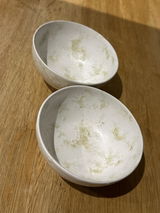
There is also hidasuki, fired wrapped in straw to leave red lines, and the set of two rice bowls includes one sangiri bowl and one hidasuki bowl.
How to Use It: In Everyday Life
What Shibaoka Chikara hopes for is that Bizen ware becomes part of everyday life, not something saved for special days.
I'd like people to bring it into their ordinary lives. One or two pieces of Bizen ware used at the table every day, flowers always arranged in a bud vase by the front door. I'd be happy if it settled into people's lives like that. The beer cup raises a fine, creamy head, and in a flower vase the water stays fresh longer, so the flowers last. For the person who made it, the best thing is when, after using a piece for a while, you realize you always reach for it.
— Shibaoka Chikara

| Type | How to use it |
|---|---|
| Beer cup | Raises a fine, creamy head. For an evening drink every day |
| Flower vase, bud vase | The water stays fresh longer and flowers last. By the front door or a window |
| Tokkuri | Pour sake and pair it with a guinomi |
| Rice bowl, donburi | For rice every day. The rice bowls come as a set of two, one sangiri and one hidasuki |
| Robot | An ornament in the line of Bizen saikumono. For a shelf or the entryway |
For a first piece, the beer cup or a bud vase is the easiest place to start. Shibaoka Chikara talks about how both feel in use, and handling them every day, you will also notice how Bizen ware changes. Flower vases and bud vases are in Shibaoka Chikara's collection.
A Sheen That Comes With Use
You can treat it like any other pottery. Wash tableware with ordinary kitchen dish soap, let it dry and use it. Over years of use, it becomes smoother to the touch and a sheen comes up on the surface. At home I use a mug every day, and after about a year it had become so glossy I wondered, did it always have this color?
The pieces we have used for guests for decades have developed an even better color, and sometimes guests we serve tea to say, "I want this one!" Each time, I turn them down and tell them to raise a beautiful one of their own.
— Shibaoka Chikara
When a piece changes in feel and color the more it is used, we say it grows. Bizen ware, made without glaze, is a kind of pottery where that change shows especially clearly. The idea of things becoming more beautiful with the years is covered in Keinen Bika.
Shibaoka Chikara's pieces can go in the microwave and dishwasher under certain conditions. They cannot go in the oven. Check the description on each product page for how to handle each piece.
What Comes Next for Shibaoka Chikara
It has to be Bizen saikumono. I have been making it for over 20 years, and I still can't do it the way I want. Among old Bizen saikumono, there are many pieces made with remarkable skill that also have charm, humor and wit. I feel that was the spirit of the artisans of the past. If I could, I would like to make work like that. I want to make things that make people say, "You can make this out of Bizen ware!?"
— Shibaoka Chikara
That wit shows in the Bizen ware robot held together with bolts and nuts. Yakishime tableware and saikumono alike, Shibaoka Chikara will keep firing both at the kiln in Imbe.

Related Articles
Learn About Bizen
- Bizen Ware: Pottery With No Glaze at All
- Bizen Pottery History: 1,200 Years from Sueki to the Tea Bowl
- Bizen Pottery Festival 2026 | A Town of the Six Ancient Kilns
Learn About Firing Colors and Kilns
- Sangiri: The Gray and Blue Bizen Gets When Buried in Ash
- Hidasuki: The Red Straw Marks on Bizen Pottery
- Yakishime: Unglazed Pottery Fired to Its Limit
- Noborigama: The Climbing Kiln, Chamber by Chamber
See the Pieces
Pottery by Shibaoka Chikara
Flower vases, bud vases, beer cups, tokkuri, rice bowls, and a robot in the line of Bizen saikumono. Fired in a wood kiln, every piece of sangiri comes out a different color, even from the same kiln.
See the piecesThis article is based on answers provided by Shibaoka Chikara.
Interview and editing: nokaze editorial team
FAQ
What is Bizen saikumono?
How is sangiri fired?
How should I care for Shibaoka Chikara's Bizen ware?
Shop the related pieces
Shibaoka Chikara
9 pieces See all
Japanese Rice Bowls
Sangiri & Hidasuki Rice Bowls, Pair — Bizen Ware
$2,151.00

Mugs
Sangiri Beer Cup — Bizen Ware
$1,690.00

Object
Sangiri Robot Figure No.1 — Bizen Ware
$2,304.00

Japanese Rice Bowls
Sangiri Donburi Bowl — Bizen Ware
$2,151.00
Bizen
78 pieces See all
Bizen Ware Artist Fujiwara Akira
Hikidashi-guro Skull Sake Cup — Bizen Ware
$5,585.00
Japanese Sake Ware

Bizen Ware Artist Fujiwara Akira
Hikidashi-guro Bamboo Plate — Bizen Ware
$5,585.00
Plates

Shimizu Yayoi
Hidasuki Small Round Plate, Arcs — Bizen Ware
$369.00
Plates

Shimizu Yayoi
Hidasuki Small Round Plate, Stroke — Bizen Ware
$369.00
Plates
New to Japanese pottery? Start here — its history, how pottery differs from porcelain, the clays and glazes behind each style, and how to care for a piece. → Japanese Pottery: The Complete Guide