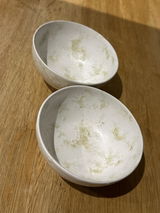

Yakishime: Unglazed Pottery Fired to Its Limit

Yakishime is the technique of firing the clay itself hard at high temperature — around 1,200–1,300°C — over a long span, with no glaze applied to the surface at all.
Ordinary pottery is coated with glaze so that it passes no water. Yakishime instead fires to the limit, making the clay particles dense enough that the piece is watertight and robust without any glaze.
Bizen ware, Shigaraki ware and Iga ware, counted among Six Ancient Kilns, are known worldwide as its representative regions.
Why it holds water without glaze
At high temperature the corners of clay particles melt and fuse to one another. This is sintering. Fired above 1,200°C for a long period, the gaps between particles close and the body itself becomes a dense structure holding glass.
It is not as complete as porcelain, though. Many yakishime pieces retain slight absorbency, and that is exactly why their expression changes with use. Doing medome at the start makes odour and staining less likely.
The scenery the kiln draws
Applying no glaze means the surface is exposed bare to the flame. And patterns nobody painted appear there.
- natural ash glaze Ash drifting in the kiln, melted at high temperature into glass.
- bidoro Ash settled thickly, melted and pooled in vivid green.
- Hiiro (fire color) Areas struck directly by flame, coming out red.
- Koge (scorch) Areas buried in ash that carbonise and burn black.
- hidasuki Straw wrapped before firing, leaving scarlet sash-like lines.
None of these can be reproduced artificially. The core of the scenery called keshiki lies in unglazed pottery.
It changes after you buy it
A yakishime piece has the gritty texture of the earth when new. Yet as you touch it daily and use it, the oils and moisture of your hands settle into the clay and it takes on a smooth sheen that seems to seep out from within.
This is keinen bika. Not a piece most beautiful on the day you buy it, but one that grows more beautiful the more it is used. Much of the reason people choose yakishime lies here.
Related terms and guides
Related terms
- Shizen-yu: Natural Ash Glaze Explained
- Bidoro: The Glass-Green Drips on Bizen Pottery
- Hidasuki: The Red Straw Marks on Bizen Pottery
- Anagama: Inside Japan's Oldest Wood-Fired Kiln
- Suyaki (Bisque Firing): What Happens in the First Fire
- Medome: How to Seal Unglazed Pottery Before First Use
- Japanese Pottery Glossary | Terms, Techniques & Kilns
- Sangiri: The Gray and Blue Bizen Gets When Buried in Ash
- Hikidashi-guro: Pulled Red-Hot From the Kiln, Turned Black
Read further
- Japanese Pottery by Region: A Buyer's Map
- Bizen Ware: Pottery With No Glaze at All
- Shigaraki Ware: Why Its Clay Sparkles After 1,200 Years
- Iga Ware: Fire, Ash and the Beauty of Rough Clay
- Keshiki: How to Read the 'Landscape' on a Pot
See the clay itself
Pottery with no glaze, where only clay and flame decide the surface. It is more beautiful three years on than on the day you bought it.
Browse unglazed stonewareFAQ
What is yakishime, and how does it differ from ordinary pottery?
What is the appeal of yakishime?
Does water soak into yakishime?
At what temperature is yakishime fired, and which regions are known for it?
Shop the related pieces
Unglazed Stoneware
99 pieces See all
Bizen Ware Artist Fujiwara Akira
Hikidashi-guro Skull Sake Cup — Bizen Ware
$5,653.00
Japanese Sake Ware

Bizen Ware Artist Fujiwara Akira
Hikidashi-guro Guinomi Sake Cup No.2 — Bizen
$3,675.00
Japanese Sake Ware

Bizen Ware Artist Fujiwara Akira
Hikidashi-guro Bamboo Plate — Bizen Ware
$5,653.00
Plates

Takezaki Yoko
Faceted Mug, Large No.5 — Bizen Ware
$1,414.00
Japanese Mugs
New to Japanese pottery? Start here — its history, how pottery differs from porcelain, the clays and glazes behind each style, and how to care for a piece. → Japanese Pottery: The Complete Guide