Hikidashi-guro: Pulled Red-Hot From the Kiln, Turned Black

Hikidashi-guro is a technique in which a piece is pulled out of the kiln at the very height of the firing and cooled suddenly so that it turns black. It is also written hikidashi-kuro.
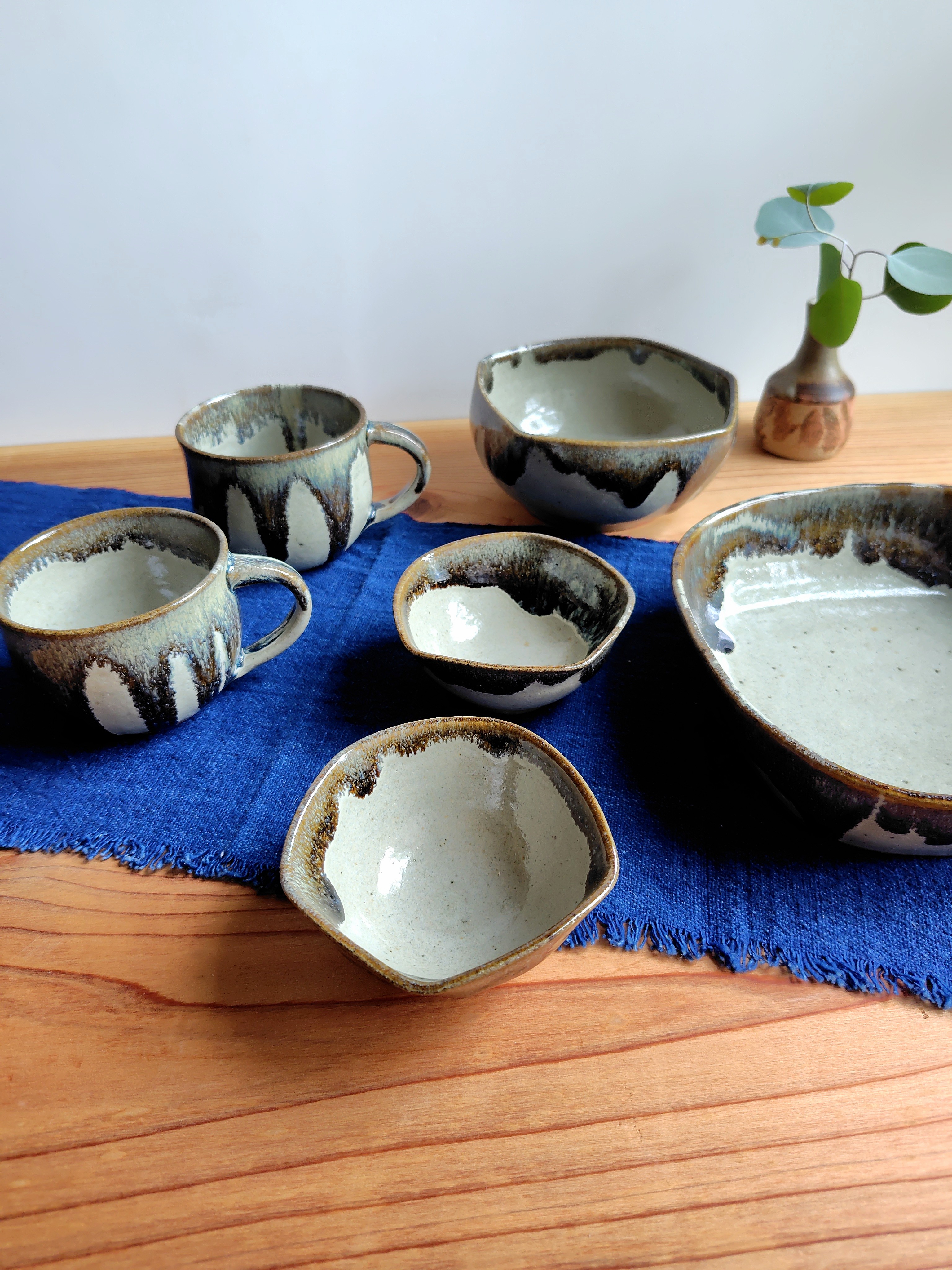
Inside the kiln it is around 1,200°C, and the pieces glow red-hot. When they are drawn out one by one with long iron tongs, they turn from red to black the instant they meet the open air. A piece that would have turned brown if left to cool slowly in the kiln sets black because it is cooled all at once.
Many pieces cannot survive the sudden change in temperature and crack. Artisans still choose this method because it gives a black that no other method can: deep like lacquer and shining like metal.
Hikidashi-guro does not belong to a single region. In Mino during the Momoyama period (1573–1615), glazed tea bowls were pulled from the kiln to create Seto-guro, and in Kyoto, black Raku tea bowls of Raku ware are pulled out and fired the same way. Today, hikidashi-guro pieces are also made in Bizen, which uses no glaze at all.
Seto-guro, black Raku and black Bizen
Pottery blackened by pulling it from the kiln divides like this by region and by whether it is glazed.
| Name | How it is made | Character of the black |
|---|---|---|
| Seto-guro | In Mino, a tea bowl coated in iron glaze is pulled out during firing. Also called Tensho-guro | A deep, sunken lacquer black with little gloss |
| Black Raku | In Kyoto's Raku ware, hand-formed tea bowls coated in black glaze are pulled out one at a time | A soft, quiet black |
| Black Bizen (hikidashi-guro) | Unglazed Bizen ware is pulled from a kiln at around 1,200°C and cooled suddenly | A black with a silver cast, like metal |
Other black pottery, such as tenmoku and iron-glazed pieces, is cooled slowly inside the kiln. In hikidashi-guro, the cooling itself is the technique. That is the difference.
Why sudden cooling turns it black
While it is firing, the iron in the clay and glaze is in a blackish state, depending on the condition of the flame. If the piece cools slowly inside the kiln, the iron gradually combines with the air (oxidizes) and returns to reddish brown or brown.
Pull it out while it is still red-hot and cool it all at once, and the surface sets before oxidation can go any further, so it stays black. Fujiwara Akira explains that the black comes from a chemical reaction caused by this sudden cooling together with strong reduction.
- Gloss The sudden cooling tightens the surface, and a metallic shine settles over the lacquer black
- Flashes of vermilion and silver Depending on how the flame and ash strike the piece as it is pulled out, vermilion and silver surface here and there
- Fragility Many pieces cannot withstand the temperature difference and crack the moment they leave the kiln

How it differs from imbede
Black Bizen has one more method, called imbede. A clay rich in iron is brushed onto the surface before firing, and that clay fires black.
Imbede pieces cool slowly in the kiln, so they rarely crack, and the black has a calm sheen. Hikidashi-guro means pulling pieces from the kiln, so only a few can be fired at a time, and many crack. In exchange, it gives a silver light and a rough, uneven surface that imbede cannot.
Fujiwara Akira, who makes black Bizen in Okayama, works with both methods. Hikidashi-guro cracks at a high rate, and working in front of that heat is grueling, but the lacquer-black gloss has kept Fujiwara committed to it. The full story is in the article on Fujiwara Akira.
Using hikidashi-guro pottery
Hikidashi-guro is a technique that leaves pieces vulnerable to sudden temperature changes. In use, too, the rule is not to switch quickly between very hot and very cold.
- Microwave, dishwasher, oven Fujiwara Akira's black Bizen cannot go in any of them, because the clay contains stones with iron in them. For other artisans' pieces, check the product page
- Use unscented detergent, diluted Unglazed yakishime absorbs smells easily
- Dry it well after washing Put away while still wet, it holds on to smells
Black pottery makes the red of sashimi, the green of leafy vegetables and the clarity of chilled sake stand out sharply. We hope you will hold a piece made with this distinctive technique in your own hands.

Related articles and terms
Black pottery and how it is fired
- Tenmoku: The Black Tea Bowl Where Iron Glaze Flows
- Yakishime: Unglazed Pottery Fired to Its Limit
- Raku Ware: The Hand-Formed Tea Bowl, 15 Generations On
- How to Choose a Matcha Bowl | Size, Shape and Region
- Sangiri: The Gray and Blue Bizen Gets When Buried in Ash
- Black Japanese Tableware Guide: Black Glaze, Hikidashi-guro and Lacquer for Food That Stands Out
Artisans who make black Bizen
- Artisan Fujiwara Akira: Pulling Bizen From the Kiln to Make It Black
- Bizen Ware: Pottery With No Glaze at All
Shop
- Fujiwara Akira | Black Bizen Sake & Tea Ware from Okayama
- Bizen Pottery | Unglazed Japanese Stoneware from Okayama
- Japanese Sake Set | Ochoko, Guinomi Cups & Tokkuri
Hold the black that came out of the kiln
What makes hikidashi-guro worth a closer look is the silver and vermilion light floating in the black. A piece that looks like a single black in a photo shows, once you tilt it in your hands, light running across every ridge. Fujiwara Akira in Okayama makes black Bizen sake ware and tea bowls pulled from a 1,200°C kiln.
See Fujiwara AkiraFAQ
What is the difference between hikidashi-guro and imbede?
Why does pottery turn black when it is pulled from the kiln and cooled suddenly?
Can hikidashi-guro pottery go in the microwave?
Shop the related pieces
Fujiwara akira
20 pieces See all

Bizen
78 pieces See all
Bizen Ware Artist Fujiwara Akira
Hikidashi-guro Skull Sake Cup — Bizen Ware
$1,437.00
Japanese Sake Ware

Bizen Ware Artist Fujiwara Akira
Hikidashi-guro Bamboo Plate — Bizen Ware
$1,437.00
Plates

Shimizu Yayoi
Hidasuki Small Round Plate, Arcs — Bizen Ware
$95.00
Plates

Shimizu Yayoi
Hidasuki Small Round Plate, Stroke — Bizen Ware
$95.00
Plates
New to Japanese pottery? Start here — its history, how pottery differs from porcelain, the clays and glazes behind each style, and how to care for a piece. → Japanese Pottery: The Complete Guide