Sangiri: The Gray and Blue Bizen Gets When Buried in Ash

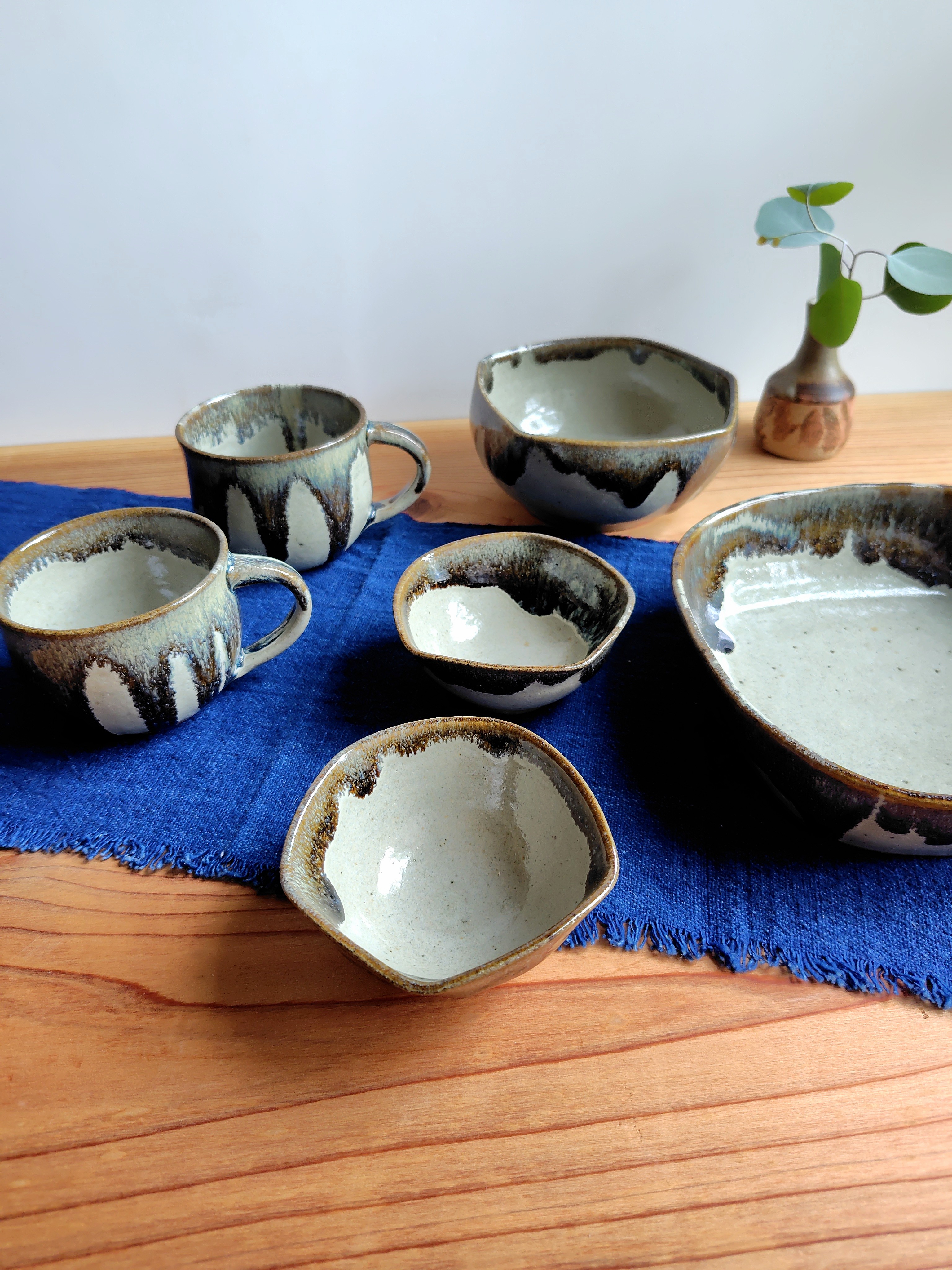
Sangiri is one of the firing colors of Bizen ware: bands of gray, blue and black that appear across a reddish-brown body.
Bizen is fired without glaze. Its colors and patterns come from nothing but clay, flame and ash. Sangiri forms where a piece was buried in ash and charcoal inside the kiln and fired without the flame touching it directly.
Nobody painted it. Until the kiln is opened, not even the artisan knows where it will appear or how. Reading that chance as a landscape is how sangiri is enjoyed.
The name is said to come from the san, the crossbars inside the kiln, since this color forms beside them. The boundary between the firebox and the firing chamber of a climbing kiln, and the places under the pieces where ash builds up, have long been where sangiri is born.
Goma, hidasuki and sangiri
The main firing colors of Bizen sort out like this by how they form.
| Firing color | What happened | What color it is |
|---|---|---|
| Goma | Wood ash falls on the piece and melts in the heat | Yellow specks. When they run, they become bidoro |
| Hidasuki | The piece is wrapped in straw and fired so the flame does not hit it directly | A pale body with red lines only where the straw lay |
| Sangiri | The piece is buried in ash and charcoal and fires with little oxygen | Bands of gray, blue-gray and black across a reddish-brown body |
All of these are colors that only appear on yakishime pottery. If goma and shizen-yu are landscapes of ash settling on a piece, sangiri is a landscape of a piece buried in ash.
Why burial in ash and charcoal turns it gray
Bizen clay is rich in iron. Fired with the flame striking it directly and plenty of oxygen around it, the iron turns reddish brown. That is the basic color of Bizen ware.
When a piece is buried in ash and smoldering charcoal, though, air stops reaching that spot. Iron fired with little oxygen (in reduction) does not turn red. It turns gray, blue or black. The deeper the burial, the darker the color; where it was shallow, the border with the reddish brown blurs into a gradient.
- Where it was buried deep Black to blue-gray. A calm color with no sheen
- The border A rainbow-like band where gray melts into reddish brown
- Where the ash began to melt A faint sheen mixed into the rough texture

Sangiri born on the kiln floor, and sangiri made with charcoal
In the past, sangiri was a rare landscape that appeared by chance only on pieces buried in ash near the floor of a noborigama or anagama.
Today there is also a way to create it on purpose by throwing a large amount of charcoal into the kiln once the temperature passes 1,200°C. This is called sumi-sangiri (charcoal sangiri): gas from the charcoal puts the area around the pieces into reduction and draws out gray and blue. Even so, the artisan cannot predict where the charcoal will settle or how much.
From the kiln of Shibaoka Chikara in Okayama, sangiri flower vases, mugs, tokkuri and rice bowls come out of the same firing. Fired in the same kiln on the same day, each one still has its gray bands in a different place and a different depth.
Using sangiri pottery
The color of sangiri is the clay itself, changed during firing. Nothing was painted onto the surface, so the color does not wear off with use.
- Seal it before first use With no glaze, the clay absorbs water. Medome makes it harder for smells and colors to soak in
- Dip it in water before use Once the clay takes in water its color deepens a shade, and food colors transfer less easily
- Dry it well after washing Stacked while still wet, it holds on to smells
The more it is used, the more it takes in oil from your hands and moisture, gaining a sheen, and the gray bands look deeper. This is called keinen bika. Care for unglazed pottery is covered in stoneware care.

Related articles and terms
Bizen firing colors
- Hidasuki: The Red Straw Marks on Bizen Pottery
- Shizen-yu: Natural Ash Glaze Explained
- Bidoro: The Glass-Green Drips on Bizen Pottery
- Yakishime: Unglazed Pottery Fired to Its Limit
- Hikidashi-guro: Pulled Red-Hot From the Kiln, Turned Black
Kilns and regions
- Noborigama: The Climbing Kiln, Chamber by Chamber
- Bizen Ware: Pottery With No Glaze at All
- Keshiki: How to Read the 'Landscape' on a Pot
- Artisan Shoen Kiln | Ten Days of Fire, Bizen for Every Day
- Artisan Shibaoka Chikara | Raised in Imbe, Carrying Bizen Saikumono Forward
Shop
Hold Bizen with gray bands running through it
What makes sangiri worth a closer look is the border where reddish brown melts into gray. A landscape that reads as a single band of color in a photo shows, once you hold it up to the light, a mix of rough texture and faint sheen. Shibaoka Chikara in Okayama makes wood-fired sangiri flower vases, sake ware and rice bowls.
See Shibaoka ChikaraFAQ
What is the difference between sangiri, goma and hidasuki?
Does the color of sangiri wear off with use?
Why does every sangiri piece have a different color?
Shop the related pieces
Shibaoka Chikara
9 pieces See all


Bizen
78 pieces See all
Bizen Ware Artist Fujiwara Akira
Hikidashi-guro Skull Sake Cup — Bizen Ware
$1,436.00
Japanese Sake Ware

Bizen Ware Artist Fujiwara Akira
Hikidashi-guro Bamboo Plate — Bizen Ware
$1,436.00
Plates

Shimizu Yayoi
Hidasuki Small Round Plate, Arcs — Bizen Ware
$95.00
Plates

Shimizu Yayoi
Hidasuki Small Round Plate, Stroke — Bizen Ware
$95.00
Plates
New to Japanese pottery? Start here — its history, how pottery differs from porcelain, the clays and glazes behind each style, and how to care for a piece. → Japanese Pottery: The Complete Guide