

Tokoname
Tokoname is where most of Japan's teapots have come from. Its iron-rich clay rounds off the astringency of green tea, so what you pour actually tastes different.
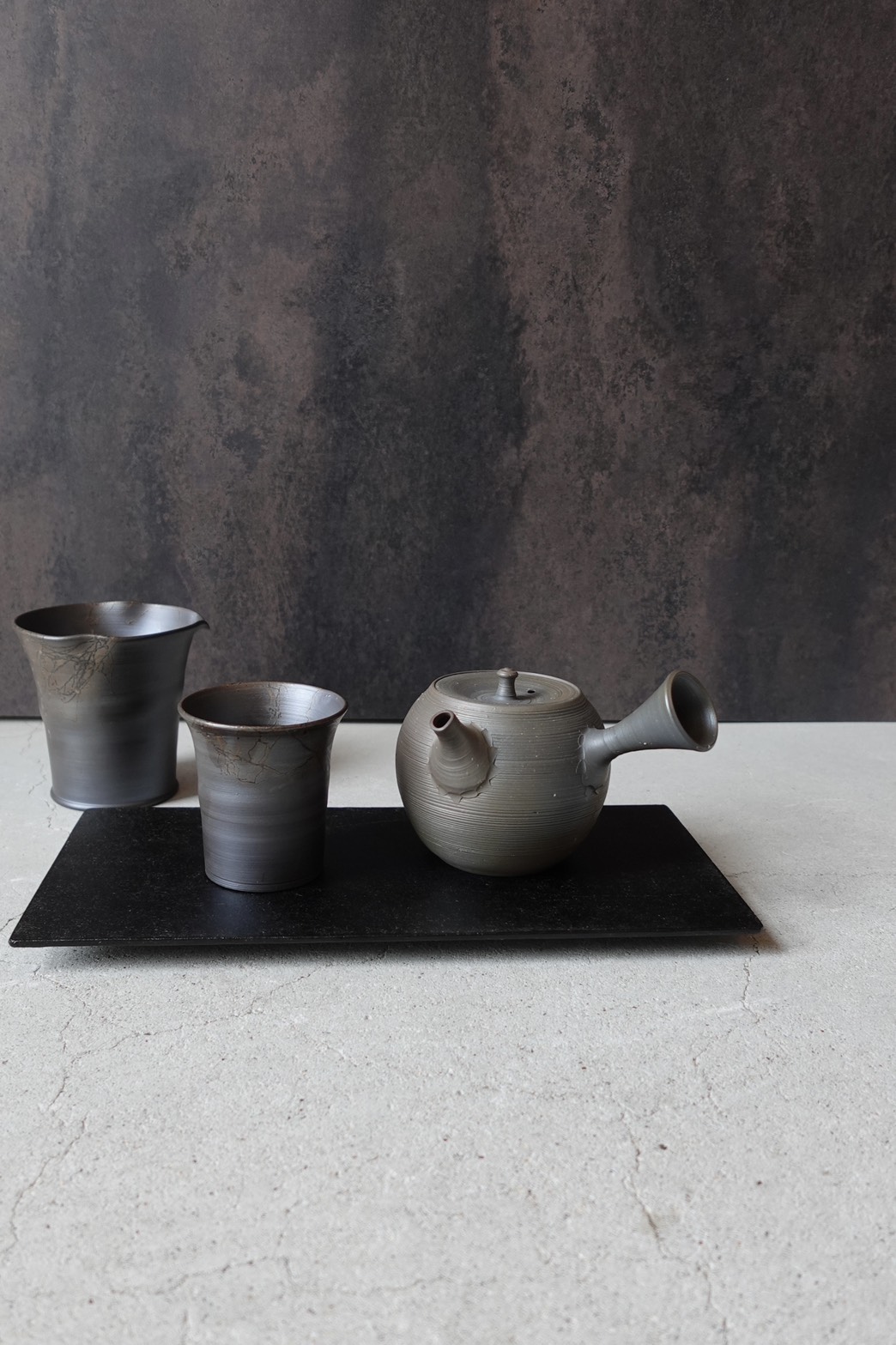
What sits here is the work of a maker born and raised in the teapot town. You notice the lightness the moment you lift one, then the fineness of the strainer. On the mogake pieces, seaweed is wrapped around the body before firing, and only where it touched does the color change, leaving greenish lines and mottling. What happened inside the kiln is the surface pattern. The cups and the vases come from the same clay and the same firing.
Tokoname is one of Japan's Six Ancient Kilns and has been firing since the Heian period. Shudei teapots suit green tea because the iron in the clay reacts gently with the tannin. There is no glaze, so the inside gains sheen with use and the outside settles under the oil of your hands. Give one teapot one kind of tea and the flavor builds. On choosing one, see Tokoname kyusu and kyusu, houhin and dobin.
Pickup Items

Tea ware
Yakishime Pear-Skin Kiln-Effect Teapot — Tokoname
$4,694.00

Flower vase
Mogake Vase, Sand — Tokoname
$1,174.00

Flower vase
Mogake Vase, Tall Black — Tokoname
$1,761.00

Flower vase
Mogake Vase, Round Black — Tokoname
$1,174.00

Flower vase
Hammered Texture Vase — Tokoname
$1,174.00

Flower vase
Mogake Vase, Amber — Tokoname
$1,174.00

Tea ware
Mogake Japanese Teacup — Tokoname Ware
$881.00

Tea ware
Mogake Yunomi Teacup, Vermilion No.1 — Tokoname
$881.00
Related Articles
All Articles-

TATA pottery studio | The Charming Kyoto Porcelain Two People Make Together
-

Arita vs Hasami Porcelain: Why the Same White Porcelain Took Two Paths
-

Arita Pottery Fair: The Usual Dates, and How to Miss the Million-Person Crowd
-

Kyoto Pottery: Where to Buy Ceramics in Kyoto
-

Iga Pottery Festival 2026: 30 Booths, and the Home of the Donabe
-

Koishiwara Folk Pottery Village Festival 2026: Free Shuttle and Traffic


