
Unofu Glaze: The Straw-Ash Glaze That Clouds to White, Layered Over Iron Glazes

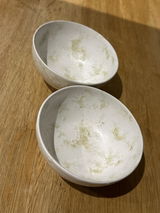
Unofu is a glaze made with straw ash and other ingredients, fired so that it turns a cloudy white. It is not transparent, and its color ranges from milky white to a soft beige. The name is said to compare it to the white of unohana (deutzia), a flower that blooms in early summer.
It is a kind of ash glaze, made by blending the ash of plants. Straw ash is rich in silica, and the part of it that never fully melts is what creates the white cloudiness. Where a clear glaze shows the color of the clay, unofu covers it softly.
It is used on its own, but also layered over or applied side by side with black and brown glazes that are high in iron. Where the two glazes overlap, the white runs, and a landscape appears along the boundary.
The full range of glazes is covered in the types of Japanese glazes. This article looks only at unofu, the straw-ash glaze that clouds to white.
How Unofu Looks
| What to look at | What unofu does |
|---|---|
| Color | Milky white to beige. Depending on how the flame reaches it in the kiln, it can take on a bluish or yellowish tint |
| Opacity | Not transparent; it softly covers the clay or glaze beneath. Where it is thin, the color below shows faintly through |
| Flow | It melts and runs in the kiln, leaving drip-like shapes at the rim and where glazes overlap |
| Texture | A soft, moist sheen. Fine crackle (kannyu) can appear where the glaze is thick |
Layered With Iron Glazes: Where Black Meets White
Unofu looks its best paired with dark brown or black glazes high in iron. When white unofu runs down over a dark glaze, a landscape like a river or snow appears along the boundary.

Fujii Naomi of "Utsuwa no Yukue," working in Yokosuka, Kanagawa Prefecture, is an artisan committed to Karatsu clay and glazes made from natural ash. A dark brown onita glaze, made with iron-rich earth and stone, is layered with a beige unofu glaze. In the tea bowl pictured, a pale bluish white flows like a band over a blackish-brown ground, and because the color changes with the thickness of the overlap, no two pieces show the same landscape. Mugs, katakuchi pourers and guinomi sake cups are made with the same two glazes.
Applying a cloudy white straw-ash glaze side by side with a black iron glaze is also known in Karatsu ware as the look called "Chosen Karatsu." For more on the region, see the article on Karatsu ware.
How to Choose and Use Unofu Pottery
- Choose by where the white runs Unofu flows differently on every piece. Decide which side is the front, and look for the side whose flow you like best
- Think about the color of the food The cloudy white gently sets off brown or green dishes, and dark tea or coffee
- Well suited to sake ware With a katakuchi or guinomi, you enjoy the color of the poured sake together with the landscape of the white glaze. How to choose sake ware is in the article on the katakuchi
Unofu is a glaze often used on stoneware. Fujii Naomi's pieces come with the instruction to pour boiling water over them before first use. Whether a piece can go in the microwave or dishwasher varies from piece to piece, so check the description on each product page. Crackle in the thick parts of the glaze can be enjoyed as part of keinen bika, the change in which the color settles in with use.
Related Articles and Terms
Understanding Glazes
- Ash Glaze (Haiyu): The Origin of High-Fired Japanese Glazes
- Japanese Pottery Glazes: The Main Types Explained
- Brown Japanese Pottery: Unglazed, Rust and Amber Glazes Compared
Region and Use
- Karatsu Ware: Kyushu's Rough, Tea-Loved Pottery
- Katakuchi: The Japanese Lipped Bowl and How to Use It
- Keinen Bika: Pottery That Gets Better With Age
See Unofu Pottery
A soft white runs down over a dark brown onita glaze. Because the color changes with the thickness of the overlap, no two pieces of the same shape show the same landscape. Browse Fujii Naomi's onita and unofu glazed pieces one by one.
See Fujii Naomi's "Utsuwa no Yukue" potteryFAQ
What kind of glaze is unofu?
What happens when onita glaze and unofu are layered?
Is there anything to watch for when using unofu pottery?
Shop the related pieces
FUJII NAOMI
5 pieces See all

Japanese Sake Ware
41 pieces See all
Bizen Ware Artist Fujiwara Akira
Hikidashi-guro Skull Sake Cup — Bizen Ware
¥20,000
Japanese Sake Ware

Utsuwa no Yukue
Pine Ash Glaze Dimpled Guinomi Sake Cup
¥2,000
Japanese Sake Ware

Utsuwa no Yukue
Oni-Unofu Glaze Katakuchi Spouted Pourer
¥4,500
Japanese Sake Ware

Ceramics - Rakudo
Polar Bear Sake Cup, Matte Grey
¥3,080
Japanese Sake Ware
New to Japanese pottery? Start here — its history, how pottery differs from porcelain, the clays and glazes behind each style, and how to care for a piece. → Japanese Pottery: The Complete Guide