Bizen Ware Marks: Reading Kiln Seals and Signatures

Turn a piece of Bizen ware over and you will often find a small mark pressed into the bare clay: a square seal, a single character, or a simple line or cross. Open the wooden box it came in and there may be more writing, brushed in ink on the lid, with a red seal beside it. For collectors outside Japan, these marks are both the most useful clue to who made a piece and the most confusing, because they are written in Japanese, often in a stylized hand, and they do not follow one system.
This guide focuses only on Bizen, the unglazed stoneware from Imbe in Okayama Prefecture. It explains why Bizen pieces carry marks at all, the difference between old kiln marks and modern artisan seals, how to tell a seal from the natural marks of the kiln fire, how to read the box, and what a mark can and cannot tell you. For marks on Japanese pottery in general, including porcelain and the "Made in Japan" stamps used on export ware, see our broader guide to pottery marks.
Want to see the marks for yourself? Every piece in our Bizen ware collection is listed under the name of the artisan who made it.
Why Bizen Pieces Carry Marks
Bizen is fired without glaze. The clay goes into the kiln bare, and the color comes from the flame, the ash and the way each piece sits in the kiln. Because there is no glaze to hide the surface, a seal pressed into the soft clay before firing survives clearly, and many Bizen artisans stamp or carve their mark on almost everything they make.
There is also a historical reason. For several centuries Bizen was fired in very large kilns shared by many workshops. When everyone's work came out of the same kiln together, a mark was the simplest way to know which pieces belonged to whom. That habit of marking has stayed part of Bizen ever since.
Four Kinds of Mark on Bizen Ware
Most marks you will find on Bizen fall into one of four groups. Knowing which one you are looking at is the first step to reading it.
| Mark | How it was made | What it usually tells you |
|---|---|---|
| Kiln mark (kama-jirushi) | A simple symbol scratched into the clay with a spatula before firing | Which workshop's piece it was in a shared kiln, mostly on older Bizen |
| Stamped seal (in) | A small carved stamp pressed into the soft clay | The artisan or the kiln that made the piece, on most modern Bizen |
| Carved signature (kakimei) | A name or character written into the clay with a pointed tool | The artisan, often on one-of-a-kind or special pieces |
| Box inscription (hakogaki) | Ink brushed on the wooden box, with a seal in red | The name of the piece, the artisan, and that the artisan approved it |
A single piece can carry more than one of these. A good modern guinomi might have a stamped seal on its base and come in a box with the artisan's name brushed on the lid. An older storage jar might carry only a scratched kiln mark on its shoulder.
Old Kiln Marks From the Great Shared Kilns
Bizen is one of Japan's oldest pottery traditions, and its history is usually traced back over a thousand years. In the later part of the Muromachi period, smaller kilns scattered around Imbe were brought together into a few very large shared kilns, in the north, south and west of the village. These great kilns were long climbing tunnels dug partly into the hillside, and remains of them can still be seen near Imbe today.
Firing in a shared kiln meant that work from several workshops was loaded together and came out together. Kiln marks, simple symbols scratched into the clay with a spatula before firing, are generally explained as the way each workshop identified its own pieces. They are usually plain shapes: a line, a cross, a circle, a few strokes. They were working marks, not signatures, and they do not name an individual potter.
If you see a large, simple scratched symbol on the shoulder or base of a jar, a mortar or a big storage piece, you may be looking at this kind of mark. Our article on Bizen history follows how the shared kilns developed.
Modern Seals: Stamped and Pressed
From the twentieth century, Bizen artisans increasingly worked under their own names and fired their own kilns. The seal changed from a workshop's marker into an artisan's signature. Today most Bizen artisans stamp their work with a small seal carved for them, pressed into the clay while it is still leather-hard.
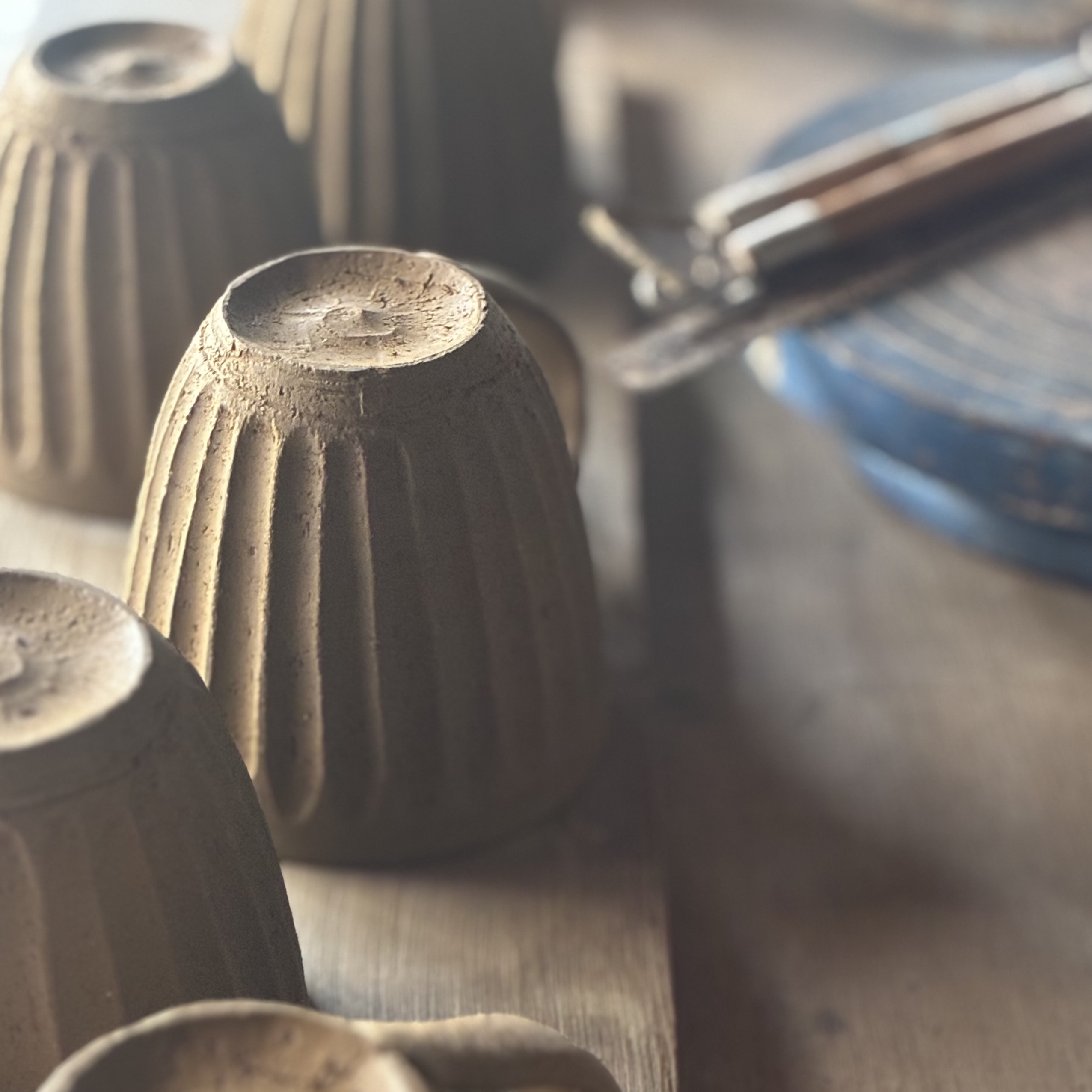
This is the most common kind of mark you will meet. A seal is usually small, often around a centimeter across, set inside a square or round frame. It might be one character from the artisan's name, two characters, or a stylized shape. On Bizen it is usually on the base, either inside the foot ring or on a flat base like the one below. On some pieces, such as tall vases or cups with a narrow foot, it is pressed low on the side near the bottom instead.

Not every mark sits in a frame. The base at the top of this page has a mark pressed straight into the clay with no border around it. The two mugs in these photos are by the same artisan, yet the marks look different. It is common for an artisan to use more than one seal over a career, or to use different marks on different kinds of work, so do not assume that one mark is the only one a person ever used.

On small or awkward shapes, the seal often goes wherever there is a flat area. On this coffee dripper it sits on the underside near the edge, away from the three drainage holes. When you look for a mark, check the whole base and the lower sides, not just the center.
Carved Signatures
Instead of a stamp, some artisans write their name or a character directly into the clay with a pointed tool. This is called kakimei, a written signature. Because it is drawn by hand each time, it varies a little from piece to piece, more like a handwritten signature than a printed one. Carved signatures are often found on one-of-a-kind pieces such as tea bowls, flower containers and larger work.
Kiln Effects Are Not Marks
Bizen's surface is covered in patterns made by the fire, and newcomers sometimes mistake them for signatures or decoration added by hand. They are worth learning, because they help you understand the piece, but they say nothing about who made it.

- Hidasuki Red-orange lines left by rice straw wrapped around the piece in the kiln. They can look like brushstrokes, but they are scorch marks. Our page on hidasuki explains how they form.
- Goma Flecks of glassy ash that fell on the piece and melted, often greenish or golden, like scattered sesame seeds.
- Sangiri Gray, blue or black patches where the piece lay buried in ash and charcoal, with little oxygen. See sangiri for more.
- Botamochi Round pale spots left where small discs were placed on a plate to stack another piece on top.
- Yohen Dramatic, unpredictable changes of color caused by the flame. Our guide to yohen covers this in detail.

The soft gray and blue patches near the base of this bowl are sangiri, where it rested in the embers. They are part of what makes each piece unique, and a reason why two Bizen pieces with the same seal never look the same. These effects are collectively called keshiki, the landscape of the piece, and our article on keshiki explains how Japanese collectors read them.
The Box: Matching the Seal on the Lid
Good Bizen pieces, especially sake cups, tea bowls and flower containers, are often sold in a fitted box of paulownia wood, called a tomobako when it is signed by the artisan. For Bizen, its most useful job is to let you check the seal on the piece against the artisan's seal on the lid.
On the outside of the lid you will usually find the name of the piece, for example "Bizen guinomi" or "Bizen hanaire" (flower container), brushed in ink. On the inside of the lid, or on its side, the artisan writes their name and presses a red seal, which is usually the same design as, or closely related to, the seal on the piece itself. Comparing the two is one of the simplest checks you can make.
Many boxes also hold a small printed leaflet, called a shiori, with a short biography of the artisan and sometimes a photo of their seal. Keep it with the box. If the piece is ever given away or sold, the box and leaflet are an important part of its story.
How to Read a Bizen Seal, Step by Step
- Find the mark Turn the piece over in good light and look at the base, the foot ring and the lower sides. A low, raking light from one side makes a pressed seal much easier to see.
- Photograph it Take a close, sharp photo straight on. Seals are small, and a photo lets you zoom in and compare later.
- Decide what kind it is Is it a framed stamp, a carved signature, or a scratched symbol? Use the table above as a guide.
- Compare with the box If there is a box, compare the seal on the piece with the red seal and the signature on the lid.
- Compare with known seals Many artisans show their seal on their website, in their exhibition catalogs or on the leaflet in the box. A gallery that sells their work can usually confirm it.
- Ask If you bought the piece from a gallery or shop, ask them. Galleries that work directly with artisans know their seals well.
What a Seal Does and Does Not Tell You
A seal is a strong clue, but it is not a guarantee. Keep these limits in mind.
- It identifies, it does not prove A seal can be copied. On its own, a seal tells you who the piece claims to be by. The clay, the firing, the form and the box together tell you whether that is likely.
- A kiln seal is not a personal seal Some workshops use one seal for everything made there, by several hands. That tells you the kiln, not the individual.
- It does not date the piece Unless you know when an artisan used a particular seal, the mark alone will not tell you when the piece was made.
- No mark does not mean no value Older everyday Bizen, and some modern pieces, carry no mark at all. Look at the clay and the firing first.
The best way to understand Bizen is to look at a piece from every angle: the shape, the fire marks on the side, and the seal on the base. Together they tell you far more than any one of them alone. Our guide to Bizen ware covers the clay, the kilns and how to care for it, and our yakishime page explains unglazed high-fired stoneware in general.
Buying Bizen With Confidence
If you want to be sure of who made a piece, buy from someone who knows the artisan. At Nokaze, every piece of Bizen we sell comes from artisans we work with directly, and each one is listed under the artisan's name. You can browse our Bizen ware by artisan, or look at the dramatic black Bizen of Fujiwara Akira, fired in Okayama. Where a piece comes with a wooden box, the listing says so, and many listings include a photo of the base, so you can see the seal before you buy.
Related Articles
Bizen Ware
- Bizen Ware: Pottery With No Glaze at All
- Bizen Pottery History: 1,200 Years from Sueki to the Tea Bowl
- Yōhen (kiln transformation)
Reading a Piece
- Japanese Pottery Marks: How to Identify a Kiln or Artisan Signature
- Keshiki: How to Read the 'Landscape' on a Pot
- Hidasuki: The Red Straw Marks on Bizen Pottery
- Sangiri: The Gray and Blue Bizen Gets When Buried in Ash
Find Bizen by the Artisan Who Made It
Unglazed Bizen ware from Okayama, listed by artisan, chosen in Kyoto and shipped to your door, packed one by one.
Shop Bizen wareFAQ
Where is the mark on a piece of Bizen ware?
What is a Bizen kiln mark?
Does a seal prove who made a Bizen piece?
Shop the related pieces
Bizen
82 pieces See all
Bizen Ware Artist Fujiwara Akira
Hikidashi-guro Skull Sake Cup — Bizen Ware
¥20,000
Japanese Sake Ware

Bizen Ware Artist Fujiwara Akira
Hikidashi-guro Bamboo Plate — Bizen Ware
¥20,000
Plates

Takezaki Noriyasu
備前苫屋香炉
¥24,200
Incense & Accessories

Takezaki Yoko
面取マグカップ
¥5,000
Japanese Mugs


New to Japanese pottery? Start here — its history, how pottery differs from porcelain, the clays and glazes behind each style, and how to care for a piece. → Japanese Pottery: The Complete Guide