
How to Tell If Japanese Pottery Is Handmade

A great deal of Japanese tableware looks handmade. Factories in Japan have spent decades learning to reproduce the soft rim, the speckled clay and the running glaze that people love in studio pottery, and many of them do it very well. So when you pick up a bowl in a shop, at a market or on a website, it is fair to ask: did a person actually make this?
You do not need to be an expert to answer that. Handmade pottery leaves evidence in a few predictable places: on the underside, inside the walls, in the weight, in the glaze and in the small differences between two pieces that are supposed to be the same. This guide shows you where to look, what each sign means, and which signs people often trust that prove nothing at all.
It is a guide to telling the difference, not to the techniques themselves. If you want to understand how pieces are thrown, coiled, built from slabs or cast in molds, our guide to the forming methods of Japanese pottery explains each one.
The pieces in our yakishime collection are made by individual artisans and fired without glaze, so the marks of the hand and the kiln stay on the surface.
Handmade or Machine-Made: The Quick Check
Most mass-produced tableware in Japan is made in one of three ways. A roller machine presses clay into a spinning mold to form plates and bowls. Liquid clay is poured into plaster molds, which is called slip casting. Or clay is pressed into a shape by machine. Decoration is often added with printed transfers instead of a brush. Each of these methods leaves its own traces, and they are different from the traces a person leaves.
| Where to look | Handmade usually shows | Machine-made usually shows |
|---|---|---|
| The foot | Cut by a tool, slightly uneven, a spiral or chatter marks inside the ring | A perfectly round ring of even height, smooth and identical on every piece |
| The walls | Faint rings from the fingers, small changes in thickness | Even thickness everywhere, no throwing lines, sometimes a thin seam from the mold |
| The weight | Varies a little between pieces, balanced in the hand | The same weight every time |
| The glaze | Thicker in some places, drips, pools, a bare patch where it was held | An even coat, or a "drip" that repeats exactly on every piece |
| Painting | Brush strokes that start and stop, colors that overlap | Crisp printed edges, tiny dots under a magnifier, an identical pattern on each piece |
| Two of a kind | Similar but never the same | Interchangeable |
No single sign settles the question. A careful potter can make walls very even, and a factory can add texture on purpose. What you are looking for is a pattern: when three or four of these signs point the same way, you can be fairly sure.
1. Turn It Over and Read the Foot
The underside is the most honest part of any piece. On a bowl or cup, the ring it stands on is called the kodai, or foot ring. On wheel-thrown pottery, the potter turns the piece upside down once it has dried to the firmness of leather, puts it back on the wheel and cuts the foot with a metal or bamboo tool. That one step leaves more evidence than anything else.

- A spiral in the center As the wheel turns, the tool leaves a spiral or a set of rings inside the foot. It is often the clearest sign of all.
- Tool marks and chatter Small ridges, a slightly ragged edge or a pattern of tiny ripples where the tool bounced on the clay.
- A foot that is not quite perfect Look along the edge of the ring. On a handmade piece its height and width change slightly as you go around.
- Bare clay Many Japanese potters leave the foot unglazed, so you can see the clay itself: its color, its grain, sometimes small stones. Factory pieces often have an unglazed foot too, but the clay looks uniform and smooth.
- A mark or seal Many artisans stamp or carve a mark into the clay near the foot. A mark pressed into the clay before firing is a good sign. A printed logo under the glaze usually points to a factory or a brand. Our guide to Japanese pottery marks explains how to read them.
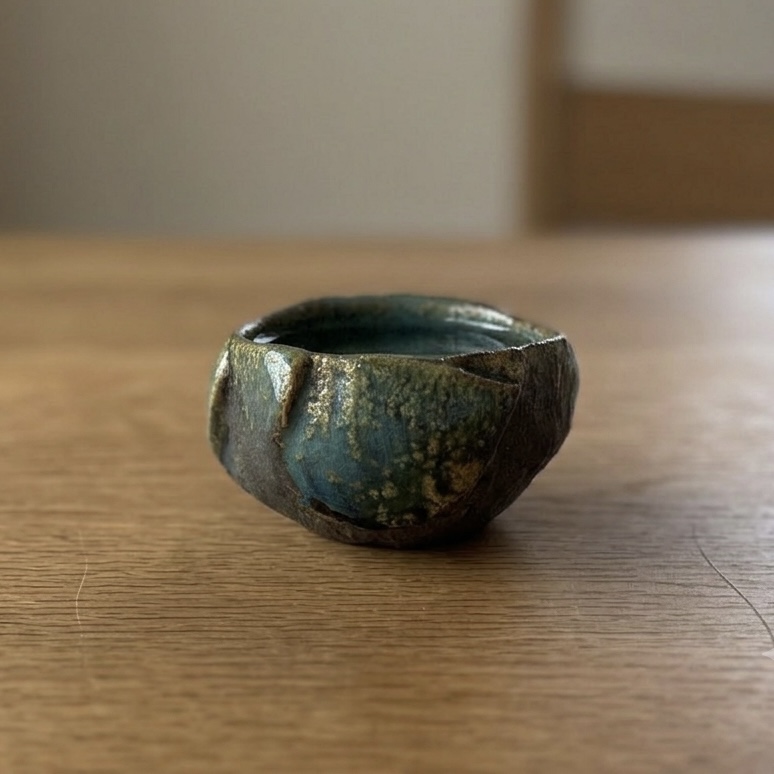
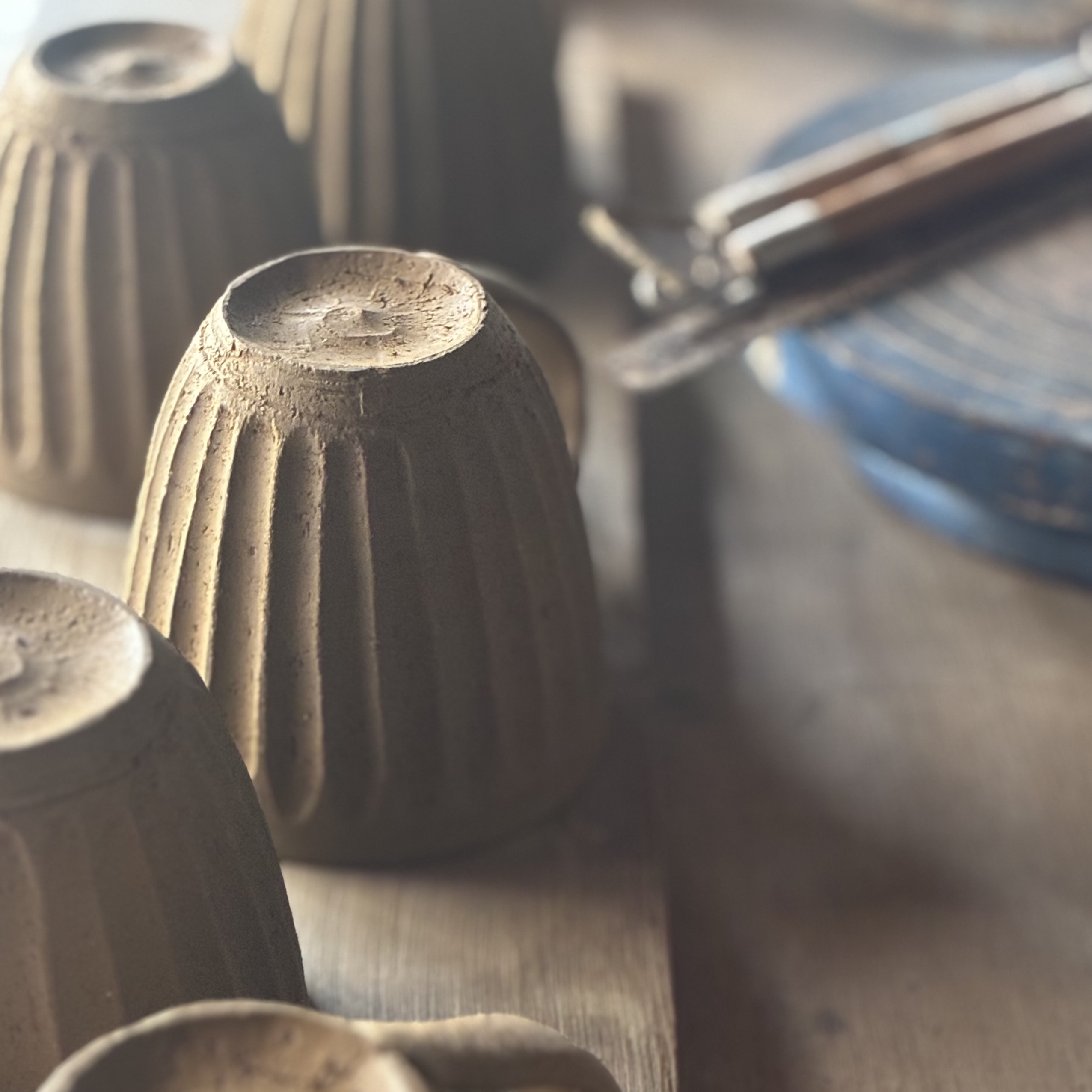
Some feet are deliberately rough or tall, as on many tea bowls, and these are almost always cut by hand. The foot below was shaped while the bowl was upside down on the wheel, and the walls above it were carved with a blade into broad facets.
2. Look at the Walls, Inside and Out
When a potter raises a piece on the wheel, the fingers pull the clay upward in a spiral and leave faint horizontal rings behind. Some potters smooth them away, but many leave them on purpose, especially inside bowls and on the outside of cups. Run a fingertip from the base to the rim and you can often feel them as gentle steps.

Throwing lines are not perfectly regular. They wander a little, change in depth and sometimes stop where the potter's hand moved. Lines pressed in by a mold look different: they repeat exactly, they are the same depth all the way around, and you will see the same lines on every piece in the set.
Also look at the rim. A thrown rim is rarely a perfect circle when you look down on it, and its thickness changes slightly as it goes around. On a slip-cast piece, the rim is usually perfectly even, and on some pieces you can find a faint line on the wall or handle where the two halves of the mold met.
3. Pick It Up and Feel the Weight
Weight is one of the best tests, and one of the most misunderstood. Handmade does not mean heavy. Skilled potters can throw very thin, light walls. What matters is how the weight is distributed.

- Balance A good handmade bowl often feels lighter than it looks, because the potter has trimmed away clay from the lower walls and foot. A factory bowl with the same outline often feels evenly heavy all over.
- Variation Pick up two pieces from the same set. Handmade pieces differ slightly in weight. Machine-made ones feel identical.
- Thickness at the rim and base Handmade walls are often a little thicker near the base and thinner toward the rim, the way the clay was pulled up. Even, uniform walls throughout suggest a mold.
4. Read the Glaze
Glaze is applied by dipping, pouring or brushing, and when a person does it, it never sits perfectly evenly. Look for glaze that is thicker in some places and thinner in others, drips that run down toward the foot, pools that gather in the bottom of a bowl, and a small bare spot or finger mark where the piece was held while it was dipped.
The firing adds its own variations. In a wood kiln, ash lands on the piece and melts into a natural glaze, and the flames leave color on one side more than the other. In unglazed yakishime, the surface is the record of the fire. The red lines on the cup above are hidasuki, marks left by straw wrapped around the piece in the kiln, and no two come out the same. Pieces like these, from our yakishime collection, are about as far from factory pottery as you can get.
Be careful with drips, though. Some factories apply a "reactive" glaze designed to run and pool, and it can look very convincing on a single piece. The test is repetition: if every bowl on the shelf has the same drip in the same place, it was designed, not fired.
5. Check the Painting Up Close
Hand-painted decoration is made of brush strokes. Each stroke has a start, often a little heavier, and an end where the brush lifts away. Colors overlap where one stroke crosses another. A line painted freehand around a rim wanders slightly and may not meet itself exactly at the end.
Printed decoration, often called a transfer or decal, looks different when you look closely. The edges are perfectly crisp, a pattern of tiny dots can sometimes be seen under a magnifying glass or a phone camera zoomed in, and the design is identical on every piece. Some transfers are applied by hand and then fired, so they are not a sign of poor quality, but they are not hand painting.
6. Compare Two of the Same Piece
This is the simplest test of all, and the one shops are most happy to let you do. Ask to see two or three of the same design next to each other. Handmade pieces from the same workshop look like a family: the same shape and glaze, but the height, the line of the rim, the position of the decoration and the fire color all shift slightly. Machine-made pieces look like copies.
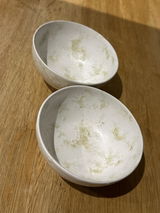
The two rice bowls at the top of this page come from the same kiln and the same series. One is larger, but look at the iron lines and the orange blush on each and you will see that no line falls in quite the same place.
7. Look at Carving and Shaping
Many Japanese potters carve or shape the clay by hand after it comes off the wheel. In shinogi, ridges are cut into the surface with a blade, one stroke at a time. Pieces may be squeezed into an oval, pressed into an uneven curve, or cut at the rim.
On hand-carved pieces, the ridges vary slightly in width and depth, and you can see where the blade entered and left the clay. Molded "carving" is perfectly regular. The same applies to deliberately distorted shapes: a hand-squeezed bowl has a gentle, organic asymmetry, while a factory "irregular" bowl repeats the same irregularity on every piece.
Signs That Prove Nothing
Several things are often taken as proof of handmade pottery, but they are not reliable on their own.
- A rough or rustic surface Texture can be molded in or sprayed on. Speckles can be added to factory clay.
- An irregular shape Factories make deliberately uneven pieces, and some artisans make very precise ones.
- "Made in Japan" It tells you where a piece was made, not how. Japan produces both fine studio pottery and large quantities of factory tableware.
- A regional name Many pottery regions have both individual artisans and large factories working under the same name. A label that says Mino or Arita does not say who made the piece.
- A mark on the base It may be an artisan's seal or a brand's logo. It tells you who stands behind the piece, but you still need to read the rest of the evidence.
- "Each piece is unique" on a label Sometimes true, sometimes marketing. Check by comparing pieces.
Handmade Does Not Only Mean Thrown
Not all handmade pottery is made on the wheel. Pieces may be pinched by hand (tebineri), built from slabs of rolled clay (tatara-zukuri), coiled, or pressed by hand into a simple mold. Square and oval plates, for example, are often made from slabs, so they will not have throwing lines or a trimmed foot ring. Look instead for the edges where slabs were joined, small finger marks, and slight changes in thickness.
Some artisans also use molds in their own studios to repeat a shape, then finish each piece by hand. These are still made by a person, one at a time, but they will look more regular than a thrown piece. Ask the shop or read the artisan's description if you are unsure.
Buying Handmade Pottery Online
Online, you cannot pick a piece up, so the photographs have to do the work. Our guide to buying Japanese pottery online covers sizes and materials. Here we focus on what the photos can tell you. A good listing for handmade pottery usually shows several things.
- The underside A photo of the foot is the single most useful image. If a shop shows it, you can read everything described above.
- Several angles Side, top and close-up views of the glaze and clay.
- A named artisan or kiln Not just a region or a brand.
- A note that pieces vary Followed by photos of the actual piece, or a clear statement that the piece you receive may differ slightly from the photo.
- Measurements for each piece Handmade pieces are often measured individually, so sizes may be given with a small range.
Most of our listings name the artisan or kiln, and many show the underside. Our Bizen ware is a good place to practice: open a few pieces and compare their feet and fire marks.
Why It Matters
Machine-made tableware is not bad. Much of it is well designed and durable, and Japan makes some of the best in the world. But a handmade piece carries something a factory piece cannot: the decisions of one person, the character of a particular clay and the record of one firing. Knowing how to see those things makes every piece you own more interesting, and helps you choose the ones you will keep for years. That is also the root of keshiki, the Japanese way of looking at the "landscape" of a pot's surface.
Related Articles
How Pottery Is Made
- How Japanese Pottery Is Shaped: Five Forming Methods
- Anagama vs Noborigama: Japanese Wood Kilns Compared
- Pottery Clay vs Porcelain Clay: How Clay Shapes a Piece
Reading a Piece
- Japanese Pottery Marks: How to Identify a Kiln or Artisan Signature
- Keshiki: How to Read the 'Landscape' on a Pot
- Bizen Ware: Pottery With No Glaze at All
- Buying Japanese Pottery Online: What to Check First
See the Marks of the Hand and the Fire
Bizen and other unglazed stoneware, each piece shaped and finished by an artisan, with the clay and the fire left to speak for themselves.
Shop yakishimeFAQ
How can I tell if Japanese pottery is handmade?
Does a signature or mark on the base mean a piece is handmade?
Is machine-made Japanese tableware lower quality?
Shop the related pieces
Unglazed Stoneware
100 pieces See all
Bizen
82 pieces See all
Bizen Ware Artist Fujiwara Akira
Hikidashi-guro Skull Sake Cup — Bizen Ware
¥20,000
Japanese Sake Ware

Bizen Ware Artist Fujiwara Akira
Hikidashi-guro Bamboo Plate — Bizen Ware
¥20,000
Plates

Takezaki Noriyasu
備前苫屋香炉
¥24,200
Incense & Accessories

Takezaki Yoko
面取マグカップ
¥5,000
Japanese Mugs
New to Japanese pottery? Start here — its history, how pottery differs from porcelain, the clays and glazes behind each style, and how to care for a piece. → Japanese Pottery: The Complete Guide