
Rinka: The Flower-Shaped Rim on Japanese Plates and Bowls

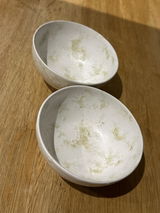
Rinka is a plate or bowl whose rim is shaped to ripple like the petals of a flower. Notches or dips are worked into the rim at even intervals, so the whole piece reads as a single open blossom.
When the tips of the petals are rounded and the rim rises and falls gently, it is called rinka. When the tips are pointed so that a sharp ridge stands at each one, it is called ryoka. Both start from the same idea: drawing a flower with the rim.
Rinka decorates with shape alone, not with color or painting. Even a plain white plate looks different with food on it once its rim begins to wave.
Names for flower-rimmed pieces vary even within one shop. Pieces with many small petals are often called kiku-zara or kiku-bachi (chrysanthemum plates and bowls), and pieces with four or five large lobes are sometimes called mokko. All of them belong to the rinka family.
Rinka, ryoka and chrysanthemum shapes
The names for flower-shaped rims sort out like this.
| Name | Shape of the rim | How it looks |
|---|---|---|
| Rinka | Petal tips are rounded and the rim waves gently | Soft, and at home with both Japanese and Western food |
| Ryoka | Petal tips are pointed, with a sharp ridge at each one | A crisp outline with the neatness of metalwork |
| Kiku (chrysanthemum) | Many small petals radiate around the rim | Fine shadows fill the rim and the piece looks lavish |
Even within rinka, the number and depth of the petals change the impression completely. Shallow, wide waves feel calm; deep, fine cuts feel lavish.

A flower shape copied from metalwork
The flower-shaped rim was not born as a pottery form. It is said to have begun when ceramics copied the flower-shaped rims of silver and gold tableware made in China during the Tang dynasty. By the Song dynasty, rinka bowls and plates in celadon and white porcelain were being made in large numbers.
In Japan, many rinka plates survive from Imari and Karatsu of the Edo period (1603–1868). Porcelain is easy to shape into rinka by katauchi, pressing the clay over a mold, and this is how fine ryoka and chrysanthemum shapes developed.
Traces of that metalwork origin still show in pottery today. The pointed rim of a ryoka plate has the tension of a thin sheet of hammered metal. Combined with seihakuji or kinsai, that impression grows even stronger.
How rinka is made
There are three main ways to shape a rim into a flower.
- Cutting After the piece is thrown on the rokuro and left to firm up a little, the rim is cut away with a small knife into petal shapes. The angle of the cut decides whether it becomes rinka or ryoka
- Pressing While the freshly thrown rim is still soft, it is pressed inward with a finger or a spatula to make dips. The more evenly spaced the presses, the neater it looks; pressing by feel leaves more movement
- Molding The clay is laid over a flower-shaped mold and tapped to take on its form. Matching pieces are easier to make this way, and fine ryoka can be made together with relief patterns
Whichever method is used, rinka can only be made before firing, while the clay is still soft. Once a piece is fired its rim cannot be changed, so the number and depth of the petals are fixed the moment the shape is decided.
Glaze pools in the notches
Look closely at a rinka piece and you will often see that the color is darker, or sometimes lighter, only where the petals meet.
During firing the glaze melts, runs and pools in the low places. In the valleys between the petals it collects thickly and the color deepens, while on the raised petal tips it thins out and the body beneath shows through. On a piece coated in white slip, only the rim fires a reddish brown, giving the look typical of kohiki.

The rise and fall of the rim becomes the light and dark of the glaze. That is why pieces of the same shape by the same artisan each look a little different.
Serving food on rinka
Because a rinka rim has so much character, food looks best gathered in the center, with a little of the rim left showing. The waving edge works like a frame, and even a small serving looks composed.
- Small plates and mamezara A single wagashi, pickles, condiments. With petals for a rim, whatever you put on it looks like a picture
- Medium plates Cake, salad, side dishes to share. They sit comfortably beside Western tableware
- Bowls Simmered dishes and anything with broth. The dips in the rim give your fingers a place to hold
How to choose the size of a rinka plate is covered in the articles on mamezara and small plates and medium plates.

Caring for rinka
The places to watch on a rinka piece are the dips in the rim and the pointed tips of ryoka. They knock against other pieces and the faucet more easily than a straight rim.
- Stack like with like Line up the petals and put a cloth or paper between pieces
- Wash one at a time Keep them from hitting other pieces in the sink
- Do not carry them by the rim Pressure on the pointed tips can chip them
Care by material is covered in stoneware care and caring for Japanese ceramics.
Related articles and terms
Shape and decoration
- Shinogi: The Carved Ridges on Japanese Pottery
- Mentori: The Faceted Surfaces of Japanese Pottery
- Seihakuji: White Porcelain Where Blue Pools in the Carving
- Icchin: Slip Trailing, the Raised Dot Technique
- Metallic Glaze: A Metal Sheen Made Without Metal
Artisans who make rinka
- Artisan Maeda Asami | Japanese Porcelain Patterned in Relief, Not Paint
- Artisan Furutani Pottery | Making Kohiki White an Everyday Piece in Shigaraki
- Artisan Shokozan | Hagi Ware Shaped by Hand, Down to the Rim
Shop
- Furutani pottery | Shigaraki Kohiki Bowls, Plates & Cups
- Maeda Asami | Bronze & Ash-Blue Glazed Porcelain, Kyoto
- Japanese Small Plates | Handmade Mamezara & Kozara
Hold a plate with a flower at its rim
What makes rinka worth a closer look is the rise and fall of the rim and the light and dark of the glaze that pools there. A rim that reads as a single outline in a photo casts a shadow at every petal once light falls across it. Furutani Pottery in Shigaraki makes rinka plates and bowls in kohiki and rust glaze for the everyday table.
See Furutani PotteryFAQ
What is the difference between rinka and ryoka?
Why are the rims of Japanese plates and bowls shaped like flowers?
Does rinka pottery chip easily?
Shop the related pieces
Furutani pottery
21 pieces See all


Japanese Plates
188 pieces See all


New to Japanese pottery? Start here — its history, how pottery differs from porcelain, the clays and glazes behind each style, and how to care for a piece. → Japanese Pottery: The Complete Guide