Tsuboya Yachimun Street: Okinawa's Pottery Quarter

Most of Japan's pottery towns are a long way from anywhere. To reach them you take a local train, then a bus, or rent a car for the day. Tsuboya is the exception. It sits in the middle of Naha, the capital of Okinawa, a short walk south of Kokusai-dori, the main shopping street. You can step off the monorail, walk through a covered market and, ten minutes later, be standing on a stone-paved lane lined with pottery shops and the remains of old kilns.
Tsuboya Yachimun Street is the heart of that quarter. Yachimun is the Okinawan word for pottery, and this lane has been a place where it is made and sold for more than three hundred years. It is short enough to walk end to end in a few minutes, but most people stay for hours: shops, galleries, a pottery museum, a working kiln site and quiet back alleys all fit into a few blocks.
This guide is about walking the street: how to get there, what to see in what order, how much time to give it, and how to choose and carry what you buy. If you want to know how to choose yachimun by shape and studio, see our yachimun buying guide. If you are planning around the annual festival, read our guide to the Tsuboya Pottery Festival. Here we stay with an ordinary day on the street.
Not traveling to Okinawa soon? Our Okinawan pottery collection brings together yachimun from studios across the islands, chosen in Kyoto and shipped worldwide.
Why a Pottery Quarter Sits in the Middle of a City
Tsuboya began with a decision by the government of the Ryukyu Kingdom. In 1682, kilns that had been scattered around the islands were brought together in one place, here, on the edge of the royal capital. Clay, fuel and skilled hands were concentrated in a single neighborhood, and Tsuboya ware was born.
For the next three centuries the quarter produced the everyday pottery of Okinawa: large unglazed jars for water, miso and awamori, and glazed bowls, plates and flasks for the table. The two lines still have names. Arayachi is the unglazed, high-fired ware for storage; joyachi is glazed ware, often painted, for daily use. Our guide to yachimun explains both in more detail.
As Naha grew into a modern city in the twentieth century, smoke from wood-fired climbing kilns became harder to live with in a crowded neighborhood. From the 1970s, many potters moved their kilns north to more open land, especially to Yomitan, where the Yachimun no Sato pottery village now stands. Tsuboya did not empty out, though. Workshops that fire with gas or electric kilns stayed, shops and galleries filled the street, and the old kilns were kept as historic sites. That is why today Tsuboya feels less like a production village and more like a living museum of Okinawan pottery, with shops attached.
Getting There
The nearest station is Makishi on the Yui Rail monorail, which runs from Naha Airport through the city. From Makishi it is about a ten-minute walk. The most enjoyable route leads you along Kokusai-dori and then south through the covered shopping arcades of Heiwa-dori, which open out at the top of Tsuboya Yachimun Street.
| From | How to get there |
|---|---|
| Naha Airport | Yui Rail monorail to Makishi Station, then about 10 minutes on foot. No transfer needed |
| Kokusai-dori | Walk south through the covered arcades. The street begins where the arcades end |
| By car | The pottery museum has no parking of its own. Use a private paid parking lot nearby, or better, leave the car at your hotel |
Driving is the one choice we would not make. The lanes are narrow and central Naha is busy, so you will spend more time looking for a parking space than walking the street. The monorail and your feet are all you need.
A Walk Down Tsuboya Yachimun Street
The street runs for about 400 meters and is paved with Ryukyu limestone, the pale coral rock you will see in walls all over Okinawa. It was laid when the pottery museum opened, and it gives the lane a soft, sunlit color even on a gray day. Here is the order we suggest, starting from the Heiwa-dori end.
1. The Tsuboya Pottery Museum
Start here, before you buy anything. The Naha Municipal Tsuboya Pottery Museum tells the story of Okinawan pottery from the earliest imported wares through the founding of Tsuboya to the present, with examples of arayachi jars, painted joyachi, and the tools potters used. Seeing the old pieces first gives you an eye for what you will find in the shops: the thick walls, the bold fish and arabesque patterns, the amber, green and cobalt glazes.
The museum opens from 10:00 to 18:00, with last entry at 17:30, and closes on Mondays (it opens when a Monday is a public holiday). Exhibitions and hours can change, so check the museum's official site before you go.
2. The shops and galleries
Shops line both sides of the street. Some belong to a single kiln and show only that workshop's pieces; others are galleries that bring together several studios, including potters based in Yomitan and on the outer islands. You will find everything from everyday rice bowls and mugs to large platters, painted flasks and shisa, the lion-dog figures that guard Okinawan roofs and gates. Tsuboya is especially known for shisa, and many shops have shelves of them in every size.
Opening hours vary from shop to shop, and some close one day a week. If there is a particular kiln you want to visit, check its own website or social media before you go.
3. Fenu-gama, the south kiln
Partway along the street, a sloping, tiled roof covers an old climbing kiln built into the hillside. This is Fenu-gama, the "south kiln," one of the kilns once used to fire arayachi. It is free to look at from outside. Notice how the kiln follows the slope: a climbing kiln is a chain of chambers that rises uphill, so heat from the lowest chamber flows into the ones above. Our glossary entry on the noborigama explains how it works.
4. The Arakaki family residence and Higashi-nu-kama
A little off the main lane stands the residence of the Arakaki family, a potter's house and workshop that was designated a national Important Cultural Property in 2002. The family is said to have come to Tsuboya when the quarter was founded. On its grounds is Higashi-nu-kama, the "east kiln," a long climbing kiln with a row of firing chambers that was used to fire Tsuboya ware until 1974. It collapsed in 2009 after heavy rain and was restored by 2015.
Part of the grounds opens to the public on set days. The open days are announced locally and change, so ask at the pottery museum. Even when it is closed, look for the large shisa on the roof, which marks the house from the street.
5. The back alleys
Step off the main street into the narrow side lanes, called sujigwa in Okinawan. Old stone walls covered in vines, small houses with red-tiled roofs, and the occasional workshop door left open make this the quietest and, for many visitors, the most memorable part of Tsuboya. It is also where you see that this is still a neighborhood where people live, so keep your voice down and do not walk into gardens.
How Much Time to Allow
The street is short, but it rewards slowness.
| Time | What you can do |
|---|---|
| About 1 hour | Walk the street end to end and look into the shops |
| About 2 hours | Add the back alleys, a café stop and Fenu-gama |
| Half a day | Add the pottery museum, the Arakaki residence if it is open, and time to compare pieces before buying |
Okinawa is warm for most of the year, and the stone street holds the heat. In summer, walk in the morning or late afternoon, carry water, and use the museum and shops to cool off. November to March is the most comfortable time to walk.
Tsuboya or Yomitan?
Visitors to Okinawa who love pottery often ask whether to go to Tsuboya or to Yachimun no Sato in Yomitan. They are different experiences, and if you have the time, do both.
| Compare | Tsuboya, Naha | Yachimun no Sato, Yomitan |
|---|---|---|
| Getting there | Monorail and a short walk | Farther north. A car makes it much easier |
| What it is | A historic quarter with shops, galleries and a museum | A village of working studios and shared climbing kilns |
| Best for | A first look, history, comparing many studios in one place | Seeing where pieces are made and buying from the potters themselves |
| Time needed | One to four hours | Half a day or more |
If you only have one day in Naha, Tsuboya fits easily between the airport and your hotel. If you are renting a car to go north to the beaches, Yomitan is on the way.
Reading Yachimun in the Shops
Pick pieces up. Yachimun is made thicker than most pottery from mainland Japan, and the weight in your hand is part of its character. A few things help you read what you are holding.

- Patterns with meanings Fish are said to bring a good catch, and the scrolling karakusa arabesque stands for growth and prosperity. Dots, waves and simple lines are common too. Many are painted quickly, in a few confident strokes.
- Southern colors Amber, deep green and cobalt blue are the classic glazes. White slip under clear glaze gives the warm cream ground you see on many plates.
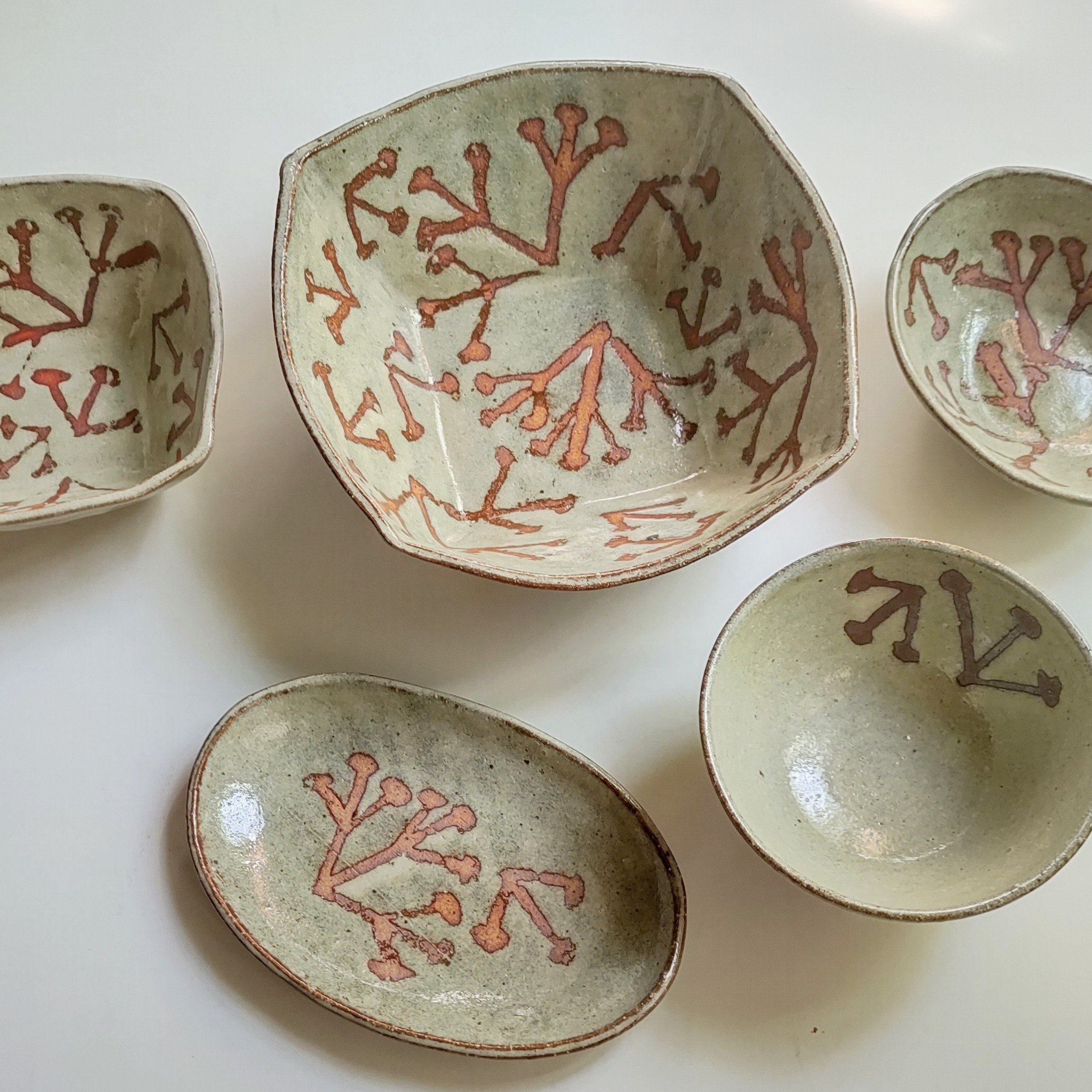
- Carved decoration Some pieces are covered in slip and then carved through to the darker clay, a technique called white slip decoration with incised lines. The bowl above shows the idea, with a scrolling band cut around the rim.
- Thick, generous forms Rims are rounded, feet are sturdy, and bowls are wide. These are pieces for daily use, not for a shelf.
Check the foot ring as well. It tells you how a piece will sit on the table and whether the unglazed clay is smooth enough not to scratch a wooden surface.

Contemporary studios add their own ideas to these traditions. You will find plates painted with citrus fruits, geometric brushwork and soft pastel glazes alongside the classic fish and arabesques. Many of the pieces in our Okinawan pottery collection come from younger studios like these.
What to Buy If You Are Carrying It Home
The thickness that makes yachimun so pleasant to use also makes it heavy. Before you start buying, think about your luggage. A large platter or a set of bowls can quickly take a checked suitcase to its weight limit.

| Piece | Carry home? | Tip |
|---|---|---|
| Small plates and cups | Easy | Wrap each one separately and pack them in the middle of a soft bag |
| Rice bowls and mugs | Manageable | Fill the inside with socks or a scarf so there is no empty space |
| Large plates and platters | Heavy | Ask the shop whether they ship, or pack them flat between clothes |
| Jars and large shisa | Hard | Ask about shipping before you buy |
Many shops wrap pieces for travel, though sometimes only lightly. Our guide to shipping pottery home from Japan covers packing, carry-on and post in detail, and our guide to pottery souvenirs lists the small pieces that travel best.

A good first piece from Tsuboya is a sobachoko, a small straight-sided cup used for noodle dipping sauce, tea, sake or a small side dish. It is light, almost impossible to break in a well-packed bag, and every studio makes its own version.
Practical Notes
- Bring cash Many shops take cards, but small workshops may not.
- Bring something to wrap with A scarf or a few small towels protect rims in your bag.
- Ask before photographing Most shops are happy for you to take pictures, but ask first inside workshops and galleries.
- Hold pieces with two hands Yachimun is heavy, and a dropped jar is a sad end to a day.
- Go early in the week if you can The museum closes on Mondays, and weekends are busier.
In November, the quarter fills for the Tsuboya Pottery Festival, held along the same street. It is a lively time to visit, but the street is crowded. For a quiet first look at the shops and kilns, an ordinary weekday is better.

Bringing Tsuboya Home
A piece of yachimun brings the warmth of Okinawa to an everyday table. The bold patterns suit simple food, the thick walls keep tea and soup warm, and the pieces only look better with years of use. Mingei potters and collectors fell in love with this ware nearly a century ago; our article on mingei tells that story.
If you cannot make the trip, or if your suitcase is already full, our Okinawan pottery collection gathers mugs, bowls, plates and cups from studios across the islands, each packed by hand in Kyoto and shipped to your door.
Related Articles
Getting to Know Yachimun
- Yachimun: The Okinawan Pottery Shaped by the Island’s Clay and Sea
- Yachimun Buying Guide: Choosing Okinawan Pottery by Shape and Studio
- Mingei: The Folk Craft Movement That Changed Pottery
Planning a Pottery Trip
- Tsuboya Pottery Festival 2026: Yachimun a Walk From Kokusai-dori
- Japanese Pottery Souvenirs: What to Buy and Where to Find It
- How to Ship Pottery Home From Japan Without Breaking It
- Pottery Regions of Japan: A Buyer's Map
The Colors of Okinawa, on Your Table
Handmade yachimun from Okinawan studios, chosen in Kyoto and shipped worldwide, packed one by one.
Shop Okinawan potteryFAQ
How do I get to Tsuboya Yachimun Street?
How much time do I need for Tsuboya?
Should I visit Tsuboya or Yomitan for pottery?
Shop the related pieces
Okinawan Pottery (Yachimun)
21 pieces See all


Japanese Plates
188 pieces See all


New to Japanese pottery? Start here — its history, how pottery differs from porcelain, the clays and glazes behind each style, and how to care for a piece. → Japanese Pottery: The Complete Guide