
Visiting Imbe: A Day in Bizen's Pottery Village

Imbe is a small town in the east of Okayama Prefecture, and almost everything about it comes back to one thing: Bizen ware. The station sits in the middle of the pottery district, the streets around it are lined with kiln shops and galleries, and tall brick chimneys rise behind the houses. Bizen has been fired here for around a thousand years, from the same local clay, in wood-burning kilns, without glaze.
Many visitors meet Imbe on the busiest weekend of its year, the Bizen pottery festival in October, when the station square fills with stalls. This guide is for the other 363 days. It covers how to get there, what is open while the station hall is being renovated, a one-day walking route, how to shop in the galleries, where to try making a piece yourself, and how to get your Bizen home in one piece. If you are planning around the festival itself, our Bizen pottery festival guide covers that weekend.
Want to see what Imbe makes before you go? Our Bizen ware collection is listed by the artisan who made each piece.
Why Imbe Is Worth the Trip
Bizen is one of Japan's oldest pottery traditions and one of the Six Ancient Kilns, the six regions that have made pottery continuously since the medieval period. Our overview of the Six Ancient Kilns puts Bizen alongside the other five. What makes Imbe special is that the whole chain is still here in one small place: the clay, the kilns, the artisans and the shops.
The clay comes from the ground beneath the rice paddies between Imbe and the neighboring Kagato district. Called hiyose, it is rich in iron and organic matter, and the Okayama tourism board explains that it is left out in the wind and rain for one to two years before it is refined and aged. It is shaped, dried and then fired for around ten days in wood-burning kilns, reaching temperatures of about 1,230°C (around 2,250°F). There is no glaze. Every color and mark on a piece of Bizen comes from the clay, the flame and the ash.
That is why Bizen rewards a visit. In a gallery in Imbe you can see dozens of pieces fired in the same kiln, side by side, and no two look alike. You can talk to the people who made them. And you can see the hills, the kiln chimneys and the clay that made them. If you would like the background first, our guides to Bizen ware and its history are a good place to start.
Getting to Imbe
Imbe is easy to reach as a day trip from Okayama, and it fits into a journey along the Sanyo Shinkansen between Osaka, Kobe and Hiroshima.
- By train Take the JR Ako Line from Okayama Station to Imbe Station. The Okayama tourism board gives the journey as about 40 minutes. Trains on this line are not frequent, so check the timetable for your return before you set out, especially in the late afternoon.
- By car Imbe is about 15 minutes from Wake Interchange on the Sanyo Expressway. While the station building is under renovation, cars and bicycles cannot enter its grounds; Bizen City directs drivers to the parking area on the north side of National Route 2.
- On foot Once you arrive, you do not need transportation. The museum, the main gallery streets, the South Great Kiln site and Amatsu Shrine are all within a short walk of the station.
Before You Go: What Is Open in 2026 and Early 2027
One important change for anyone using an older guidebook. The Bizen-yaki Traditional Industry Hall, the kiln-shaped building that forms part of Imbe Station and used to house a tourist information center and a large shop of artisans' work, is closed for renovation. According to Bizen City, the building and the area around it are off-limits from April 20, 2026 until February 26, 2027 (planned). Bizen City says you can still walk through the station passage to and from the trains, and that while the restrooms inside the hall are closed, temporary toilets are provided outside.
The other main stops were open as usual when we checked. Here is a summary, based on the official pages at the time of writing. Hours change, so check before you travel.
| Place | What you will see | From the station | Good to know |
|---|---|---|---|
| Bizen City Museum of Art | Exhibitions of Bizen ware and other art, on the site of the former Bizen pottery museum | 1-minute walk | 9:00 to 17:00, last entry 16:30. Closed Mondays (the next day if Monday is a holiday) and over New Year, and may close between exhibitions |
| Imbe South Great Kiln site | Remains of three large shared kilns and a huge mound of discarded shards | About 5 minutes | A national historic site, open to walk around |
| Amatsu Shrine | Roof tiles, guardian dogs, paving stones and wall plaques made of Bizen ware | About 10 minutes | Bizen ware votive plaques (ema) are sold at the shrine |
| Former Shizutani School | A 17th-century school whose lecture hall is a National Treasure | Bus or taxi, see below | Gate open 9:00 to 17:00. Closed for a few days at the end of December |
A One-Day Walking Route
Imbe is compact. You can see the essentials in a relaxed day on foot, with time left for shopping. Here is the order we would suggest on a weekday.
- Morning: the museum Start at the Bizen City Museum of Art next to the station. Seeing a range of old and modern pieces first gives you an eye for what you will find in the shops: how the colors vary, which fire marks are prized, and how thick and heavy good Bizen can be.
- Late morning: the South Great Kiln site A short walk away, the remains of the South Great Kiln are one of the most striking sights in Japanese ceramics. This was one of the very large shared kilns that served the whole village from the Muromachi period into the Edo period. The Okayama tourism board describes the eastern kiln as 53.8 meters long. Beside the kilns rises a mound of broken pieces thrown away over the centuries.
- Midday: the gallery streets Walk back through the streets around the station, where kiln shops and galleries stand side by side. This is where you will spend most of your time. Stop for lunch on the way.
- Afternoon: Amatsu Shrine Finish at Amatsu Shrine, where Bizen ware is used almost everywhere you look: the roof tiles, the guardian dogs, the paving of the approach, and plaques set into the wall along the path. It is a quiet, unusual place and a good end to the day.

A Guided Walk on Weekends
If you are in Imbe on a Saturday or Sunday, there is a guided town walk led by local guides as part of JR West's Discover West hiking program. According to the Okayama tourism board, walks leave from JR Imbe Station at 10:00 and 13:00 on Saturdays and Sundays from April 2026 to March 2027, except in July, August and over New Year. No reservation is needed, and there is no fee for the guide. The walk takes about two hours and covers about 3 kilometers, passing Amatsu Shrine, Inbe Shrine, the Miyayama viewpoint, the North Great Kiln site, a working kiln and the South Great Kiln site. The guides are local volunteers, so if you need English, call the Bizen City tourism office in advance to ask what is possible. Walks can be canceled in bad weather.
Shopping in the Galleries and Kiln Shops
Imbe has a mix of shops. Some are the showrooms of a single kiln, often in front of the workshop and run by the family. Others are galleries showing the work of several artisans. Both are worth your time. The kiln shops let you meet the person who made the piece; the galleries let you compare many artisans at once.

A few things will help you shop well:
- Pick it up Bizen is meant to be handled. Hold a cup in your hand, feel the weight of a plate, run your thumb over the surface. Use both hands, and set pieces down gently. If you are not sure, ask first.
- Look at the base Most pieces carry the artisan's seal, pressed into the clay near the foot. Ask whose it is. Shop owners are usually happy to tell you about the artisan and the kiln.
- Look at the whole surface Turn the piece slowly. The side that faced the flame may look completely different from the side that faced away.
- Ask about the box Better pieces often come with a wooden box signed by the artisan. It protects the piece on the journey home and records who made it.
- Check opening days Shops set their own hours and closing days. Many close on one weekday, which differs from shop to shop, and many close over New Year. If there is a particular kiln you want to visit, check ahead.
- Ask before photos Most shops are fine with photos of the street and the shop front. Inside, and especially in workshops, ask first.
What to Look For in Bizen
Because Bizen has no glaze, it is judged by the marks of the fire. These are the ones you will hear about in the shops. Knowing their names makes conversations with artisans much easier.

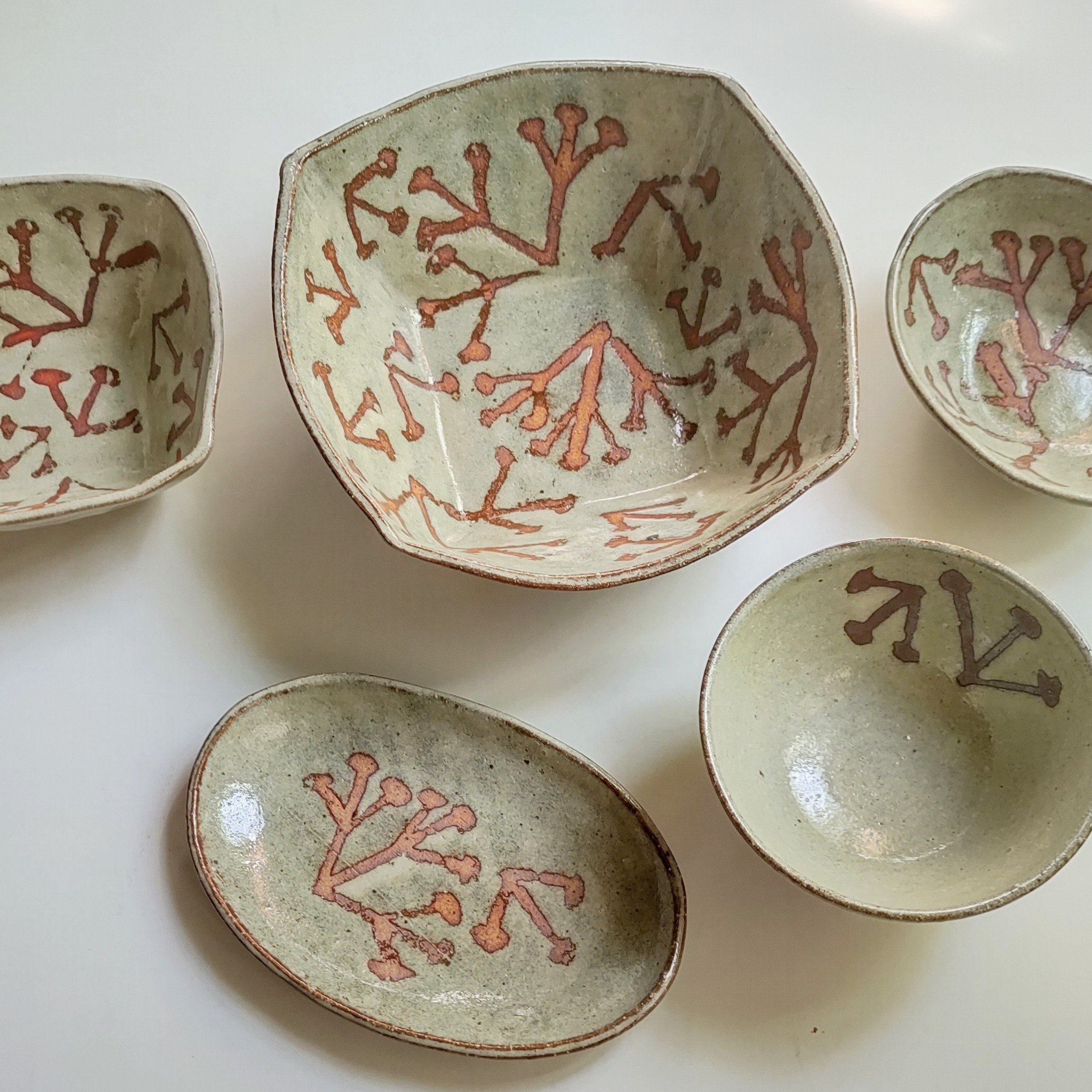
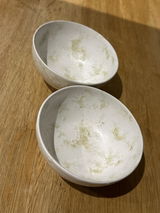
- Hidasuki Red-orange lines left where rice straw was wrapped around the piece in the kiln. The plate above shows a dense web of them. Our page on hidasuki explains how they form.
- Goma Flecks of wood ash that landed on the piece and melted into a glassy, often greenish or golden skin. It is a kind of natural ash glaze.
- Sangiri Gray, blue or black patches where the piece lay buried in ash and charcoal. See sangiri for more.
- Botamochi Round pale marks left where small clay discs were placed on a plate to stack another piece on top.
- Yohen Dramatic, unpredictable changes of color caused by the flame. Our guide to yohen covers them in detail.

Bizen also comes in more forms than most visitors expect. Alongside sake cups, tea bowls, flower containers and plates, you will find mugs, coffee drippers, beer cups and sculptural work. Imbe has a long tradition of saikumono, finely modeled figures and objects in Bizen clay, and some younger artisans are taking it in new directions. Our profile of Shibaoka Chikara, who grew up in Imbe, shows one example.
Trying Your Hand at Bizen
Several kilns in Imbe offer clay-shaping sessions for visitors, where you can make a cup or small dish by hand with an artisan's guidance. They generally need a reservation, so book before you travel. The Okayama tourism board notes that pieces made in these sessions take about one to two months to be fired, because they go into the kiln with the artisans' own work. You can come back to collect them or have them shipped to you, with shipping charged separately. If you live outside Japan, ask the kiln when you book whether they can ship abroad.
Most sessions are hand-building rather than the wheel. Our page on tebineri explains the method, and our guide to pottery classes in Japan compares workshops in other regions.
A Side Trip: The Former Shizutani School
If you have extra time, the Former Shizutani School is one of the most beautiful historic sites in Okayama and has a direct connection to Bizen. Founded in the 17th century as a school for ordinary people, it is known for its lecture hall, a National Treasure, whose roof is covered in tiles of Bizen ware.
It is in the hills north of Imbe. The school's official site lists small Bizen City buses from JR Iri Station on the Ako Line, and from JR Yoshinaga Station on the Sanyo Line, as well as local taxis. The buses are not frequent, so check the timetable on the school's website before you go, or take a taxi from Imbe. The gate is open from 9:00 to 17:00. The school's site notes that visitors can walk along the outer corridor of the lecture hall but cannot go inside, and that food and drink are not allowed on the grounds.
When to Go
- Weekdays The quietest time. Shops are calm, and artisans have time to talk. Avoid Mondays if you want to see the museum.
- Weekends A little busier, and the time to join the guided town walk.
- The October festival The Bizen pottery festival is usually held on the third Saturday and Sunday of October. It is the most lively time to visit, with stalls all around the station, but also the most crowded.
- Spring and autumn The most comfortable seasons for walking. Summer in Okayama is hot and humid, and the guided walks pause in July and August.
- New Year Many shops and sites close for several days around January 1.
Getting Your Bizen Home
Bizen is thick and heavy for its size, which makes it robust, but it can still chip if two pieces knock together. Ask the shop to wrap each piece separately; most are very good at it. Carry small, precious pieces such as sake cups in your hand luggage, padded with clothing. For larger plates and flower containers, many kiln shops can ship within Japan, and some can ship abroad. Ask when you buy.
If you fall for a large piece and the logistics feel daunting, it is also fine to note the artisan's name and look for their work online when you get home.
Bizen From Imbe, When You Cannot Go
Not everyone can fit a day in Imbe into a trip to Japan. At Nokaze, we work directly with Bizen artisans, and every piece in our Bizen ware collection is listed under the name of the person who made it. You will find the hidasuki cups and plates of Takezaki Noriyasu, the tea bowls of Takezaki Yoko, the black Bizen of Fujiwara Akira, and the sangiri work of Shibaoka Chikara. For unglazed high-fired pieces from other regions too, browse our yakishime collection.
Related Articles
Bizen Ware
- Bizen Ware: Pottery With No Glaze at All
- Bizen Pottery History: 1,200 Years from Sueki to the Tea Bowl
- Bizen Pottery Festival 2026 | A Town of the Six Ancient Kilns
- Artisan Shibaoka Chikara | Raised in Imbe, Carrying Bizen Saikumono Forward
- Artisan Fujiwara Akira: Pulling Bizen From the Kiln to Make It Black
Kilns and Fire Marks
- Japan's Six Ancient Kilns: All 6 Regions Compared
- Anagama vs Noborigama: Japanese Wood Kilns Compared
- Hidasuki: The Red Straw Marks on Bizen Pottery
- Yakishime: Unglazed Pottery Fired to Its Limit
Planning a Pottery Trip
- How to Visit a Japanese Pottery Fair: 9 Regions Compared
- Pottery Classes in Japan: Where to Try the Wheel
Bring Imbe Home
Unglazed Bizen ware from the kilns of Imbe, listed by artisan, chosen in Kyoto and shipped to your door, packed one by one.
Shop Bizen wareFAQ
How do I get to Imbe from Okayama?
Is the Bizen-yaki Traditional Industry Hall at Imbe Station open?
Can I make my own Bizen pottery in Imbe?
Shop the related pieces
Bizen
78 pieces See all
Bizen Ware Artist Fujiwara Akira
Hikidashi-guro Skull Sake Cup — Bizen Ware
¥20,000
Japanese Sake Ware

Bizen Ware Artist Fujiwara Akira
Hikidashi-guro Bamboo Plate — Bizen Ware
¥20,000
Plates

Shimizu Yayoi
Hidasuki Small Round Plate, Arcs — Bizen Ware
¥1,320
Plates

Shimizu Yayoi
Hidasuki Small Round Plate, Stroke — Bizen Ware
¥1,320
Plates
Unglazed Stoneware
97 pieces See all
Bizen Ware Artist Fujiwara Akira
Hikidashi-guro Skull Sake Cup — Bizen Ware
¥20,000
Japanese Sake Ware
Bizen Ware Artist Fujiwara Akira
Hikidashi-guro Bamboo Plate — Bizen Ware
¥20,000
Plates

Shimizu Yayoi
Hidasuki Mosaic Bread Plate — Bizen Ware
¥5,500
Plates
Shimizu Yayoi
Hidasuki Small Round Plate, Stroke — Bizen Ware
¥1,320
Plates
New to Japanese pottery? Start here — its history, how pottery differs from porcelain, the clays and glazes behind each style, and how to care for a piece. → Japanese Pottery: The Complete Guide